PagerDuty Nodes
Page the on-call engineer, clear the incident when the condition clears, and read what is open.
- Needs
- A PagerDuty connection with a REST API key
- Operations
- Send Event, Send Change Event, List Incidents
- Output
- The deduplication key, or the incident list
PagerDuty routes alerts to whoever is on call for a service. MaestroHub's PagerDuty nodes send alert and change events through PagerDuty's Events API v2 and read incidents through its REST API.
Configuration Quick Reference
| Field | What you choose | Details |
|---|---|---|
| Parameters | Connection, Function, Function Parameters, Timeout Override | Select the connection profile, function, configure function parameters with expression support, and optionally override timeout. |
| Settings | Description, Timeout (seconds), Retry on Timeout, Retry on Fail, On Error | Node description, maximum execution time, retry behavior on timeout or failure, and error handling strategy. All execution settings default to pipeline-level values. |
Every node delivers its data under result, and execution facts (success, functionId, durationMs, timestamp) under _metadata, with the call's own facts in $node["Name"]._metadata.method (the operation), $node["Name"]._metadata.connectionId (the connection it ran over) and $node["Name"]._metadata.protocol (pagerduty).
PagerDuty Send Event Node
PagerDuty Send Event Node
Triggers an alert on a PagerDuty service, or acknowledges or resolves the open alert with the same deduplication key. A trigger with an open alert's key updates that alert instead of paging again.
A trigger pages real people. The node sends each event once and never re-sends it on its own; Retry on Fail and store-and-forward may send it again, and the deduplication key folds such a resend into the same alert.
Output
| Expression | Description |
|---|---|
$node["Name"].result.eventAction | What was sent: trigger, acknowledge or resolve |
$node["Name"].result.status | PagerDuty's answer, success when it accepted the event |
$node["Name"].result.message | PagerDuty's message, e.g. Event processed |
$node["Name"].result.dedupKey | The key PagerDuty filed the alert under: the one sent, or the one it generated. Pass it to an acknowledge or resolve to act on the same alert |
PagerDuty Send Change Event Node
PagerDuty Send Change Event Node
Records a change (a deploy, a recipe or configuration change, a shift handover) on a PagerDuty service. It pages no one; responders see it on the service's timeline beside its incidents.
Output
| Expression | Description |
|---|---|
$node["Name"].result.status | PagerDuty's answer, success when it accepted the change event |
$node["Name"].result.message | PagerDuty's message, e.g. Change event processed |
PagerDuty List Incidents Node
PagerDuty List Incidents Node
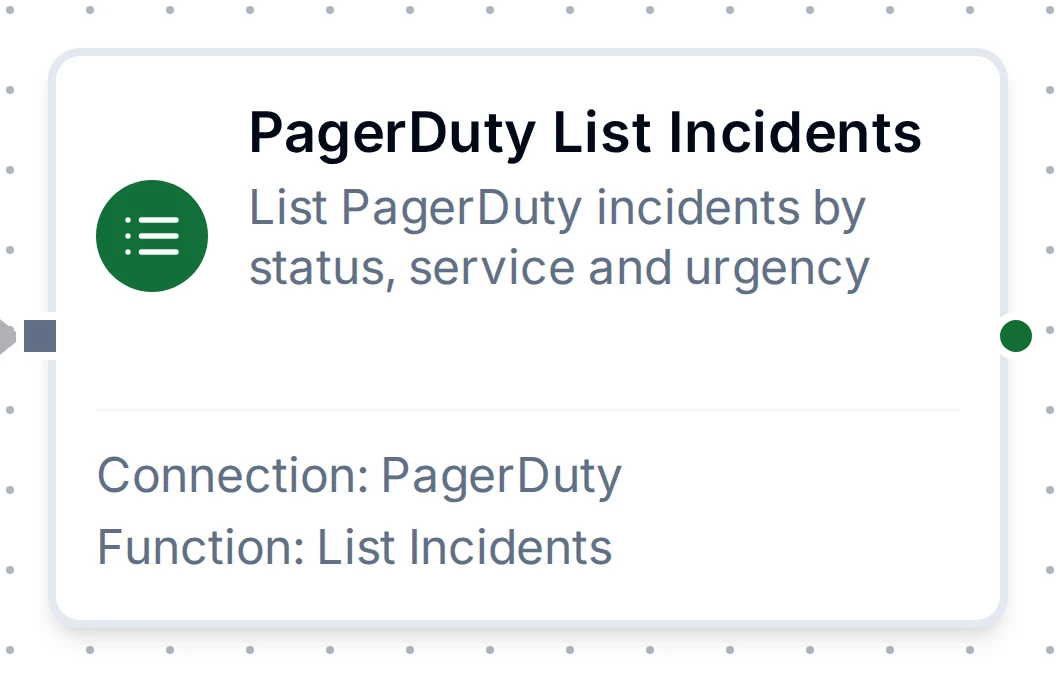
Lists incidents, newest first, filtered by status, service and urgency; by default the open ones (triggered and acknowledged) of every service.
Output
| Expression | Description |
|---|---|
$node["Name"].result.incidents | One object per incident: id, incidentNumber, title, status, urgency, createdAt, serviceId, serviceName, incidentKey (the alert's deduplication key) and htmlUrl |
$node["Name"].result.count | How many incidents this call returned |
$node["Name"].result.more | true when PagerDuty holds more matching incidents than the limit let through |
The service list you see while building a function comes from the connection's service picker. It is not a function you can save, so no node returns it.
For every function field, see the PagerDuty Integration Guide.