Saia PCD Nodes
Read and write registers, timers, counters, flags and outputs on Saia PCD controllers, and read their inputs, data blocks and state, from a pipeline.
- Operations
- Read Device · Read Block · Write Device · Read Station
- Limits
- 32 registers or 128 bits a telegram
- Writes
- One telegram, whole or not at all; never buffered
Use Saia PCD controllers in pipelines. Each function authored on a Saia PCD connection is available as a matching node in the Pipeline Designer: Saia PCD Read Device, Saia PCD Read Block, Saia PCD Write Device and Saia PCD Read Station.
For connection setup (the station number, gateway stations and the waits), the addresses, data types and float formats, see the Saia PCD connection guide.
A PCD does not send data on its own, so there is no trigger node: to poll one, drive the reads from a Schedule trigger.
Configuration Quick Reference
| Field | What you choose | Details |
|---|---|---|
| Parameters | Connection, Function, Function Parameters, Timeout Override | Select the Saia PCD connection, pick a function, bind parameters with expression support, and optionally override the timeout. |
| Settings | Description, Timeout (seconds), Retry on Timeout, Retry on Fail, On Error | Node description, maximum execution time, retry behaviour and error strategy. All execution settings default to pipeline-level values. |
Every node shares the same Parameters: Connection (the Saia PCD connection profile), Function (a function of the node's type on that connection), Function Parameters (auto-populated from the function schema, with expression syntax {{ expression }} for dynamic values) and an optional Timeout Override in seconds. Each node receives the output of the previous node as input, which function parameter expressions can reference as $input.
The call's own facts ride along under _metadata next to the four every connected node carries. Every Saia PCD node delivers _metadata.method (the operation that ran, e.g. saia.read.device), _metadata.connectionId (the connection it ran over) and _metadata.protocol (saia).
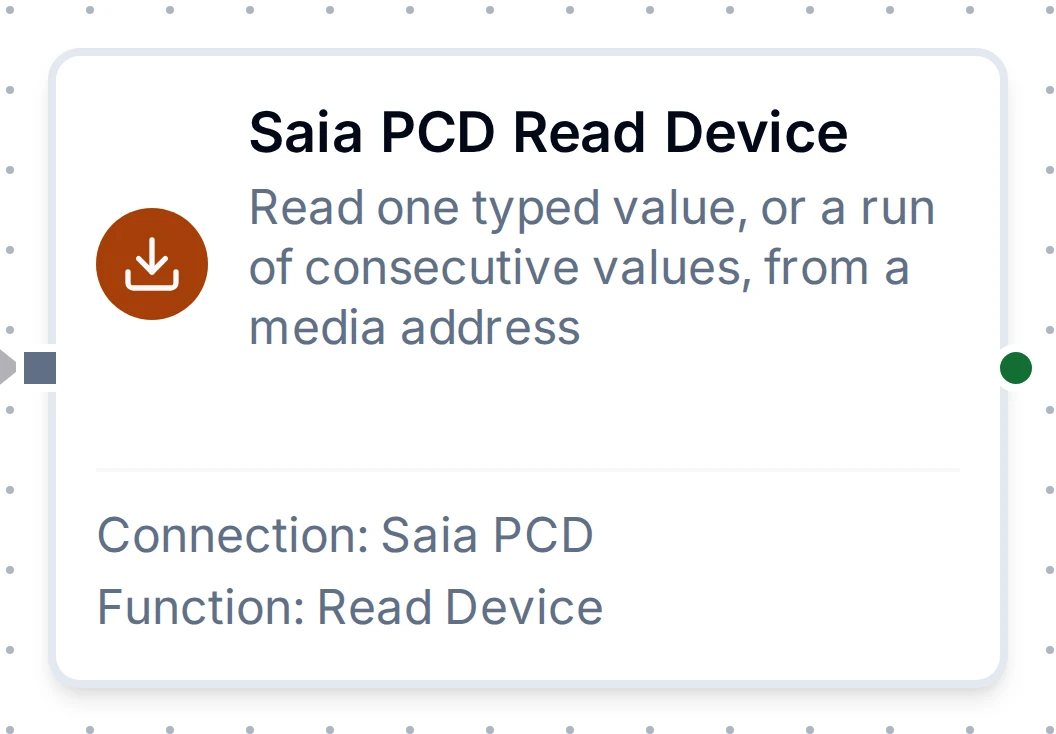
Read Device node
Saia PCD Read Device Node
Supported Function Types:
| Node | Function | Purpose | Common Use Cases |
|---|---|---|---|
Saia PCD Read Device (connected.saia.read.device) | saia.read.device | Read one typed value, or a run of consecutive values, from a media address | A temperature on a schedule, a run-hours counter, an alarm flag |
The node reads the address the function names, as its data type, or Count consecutive values. See Read Device for the parameters and Addresses for the data types each medium holds.
Output Structure
{
  "result": {
    "device": "R100",
    "dataType": "REAL",
    "value": 21.5,
    "quality": "good"
  }
}
With Count more than 1, value is a list.
| Key | Meaning |
|---|---|
result.device | The address read, in one standard form: r100 comes back as R100 |
result.dataType | The type the value was decoded as: BIT, DINT, DWORD or REAL. An empty data type comes back as the medium's own |
result.value | The value: a number, or true/false for a bit. A list of values when Count is more than 1 |
result.quality | good. A refusal by the PCD fails the node instead of storing a value, so a value that reached the result is the PCD's own reading |
Read a value with $node["Supply Temperature"].result.value.
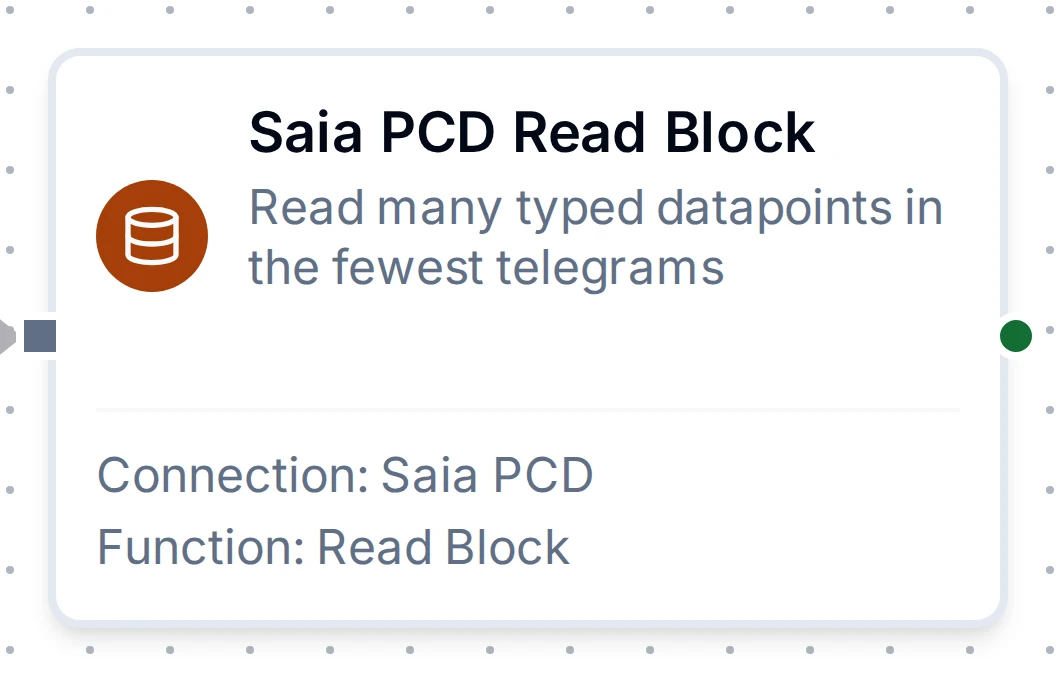
Read Block node
Saia PCD Read Block Node
Supported Function Types:
| Node | Function | Purpose | Common Use Cases |
|---|---|---|---|
Saia PCD Read Block (connected.saia.read.block) | saia.read.block | Read many typed datapoints in the fewest telegrams | A plant room's temperatures, setpoints and alarm flags in one node |
The node reads every point of the function and returns each value by its name. Points of the same medium are read in one telegram, with what lies between them, when they fit. A point the PCD refuses is reported by name without failing the others; the node fails only when the station does not answer at all. See Read Block for the parameters.
Output Structure
When every point was read:
{
  "result": {
    "count": 3,
    "values": { "SupplyTemp": 21.5, "ReturnTemp": 18.25, "PumpAlarm": false },
    "quality": "good",
    "totalDataPoints": 3,
    "totalReads": 2
  }
}
Here SupplyTemp (R100) and ReturnTemp (R101) share one telegram and PumpAlarm (F2000) takes a second.
When a point was not read, it is missing from values, its reason is in errors under its name, and quality is bad:
{
  "result": {
    "count": 2,
    "values": { "SupplyTemp": 21.5, "PumpAlarm": false },
    "errors": {
      "Spare": "saia: station 10 refused the request: NAK 1, no reason given: the PCD does not have the address, does not carry out the command, or will not take the value"
    },
    "quality": "bad",
    "totalDataPoints": 3,
    "totalReads": 3
  }
}
| Key | Meaning |
|---|---|
result.values | Every point that was read, by its name |
result.errors | The reason for each point that was not read, by its name. Present only when a point was not read |
result.count | How many points were read |
result.totalDataPoints | How many points were requested |
result.totalReads | How many telegrams the points were merged into, including the telegrams that asked again point by point after a refusal |
result.quality | good when every point was read, bad when one was not |
Read a point with $node["Plant Room"].result.values.SupplyTemp. Check $node["Plant Room"].result.errors before relying on every point being present.
Write Device node
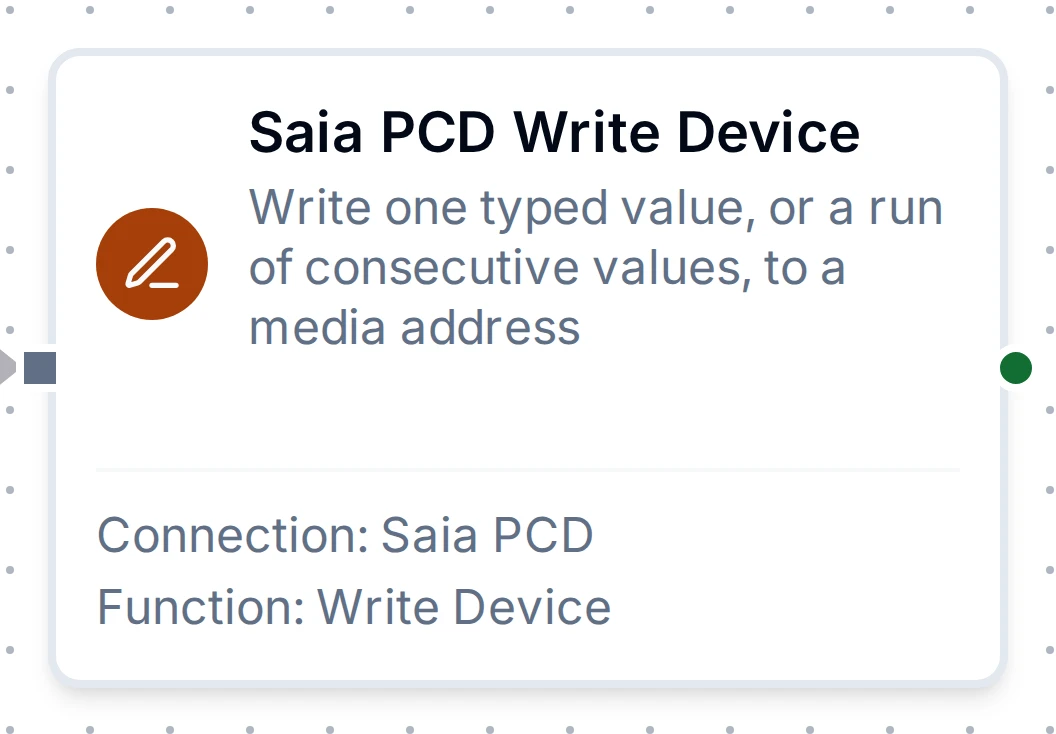
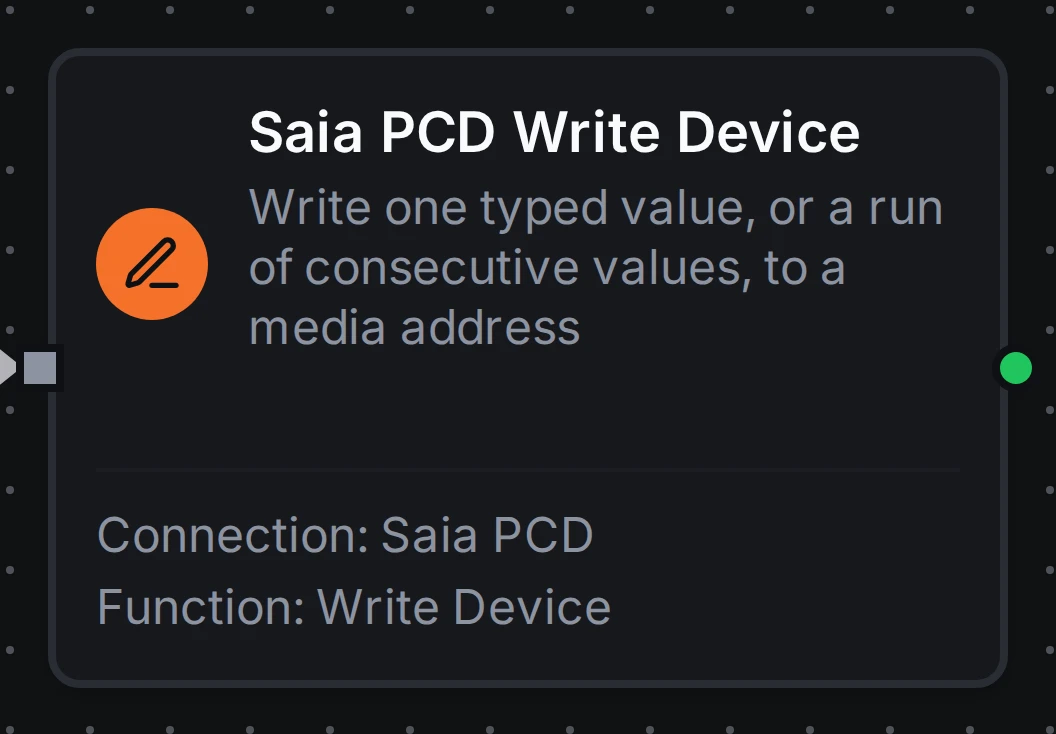
Saia PCD Write Device Node
Supported Function Types:
| Node | Function | Purpose | Common Use Cases |
|---|---|---|---|
Saia PCD Write Device (connected.saia.write.device) | saia.write.device | Write one typed value, or a run of consecutive values, to a media address | Setpoints, schedules, operating modes, switching an output |
The node writes the function's value, or a list of values to consecutive addresses, in one telegram: up to 32 registers, timers or counters, or 128 flags or outputs. Inputs, data blocks and single bits inside a register cannot be written. See Write Device for the parameters and the write rules.
A write is never buffered for later delivery, and it is refused in a run started by a late (replayed) input unless the node allows late input. A value that does not fit its type fails the node before anything is sent to the PCD.
Output Structure
{
  "result": {
    "device": "R200",
    "dataType": "REAL",
    "value": "21.5"
  }
}
| Key | Meaning |
|---|---|
result.device | The address written, in one standard form: r200 comes back as R200 |
result.dataType | The type the value was encoded as: BIT, DINT, DWORD or REAL |
result.value | The value as given, after parameter substitution: "21.5", or the list "[21.5, 19.0]" |
Always validate values in a Condition node before writing to a PCD. A setpoint or an output can move a damper, valve or pump immediately.
Read Station node
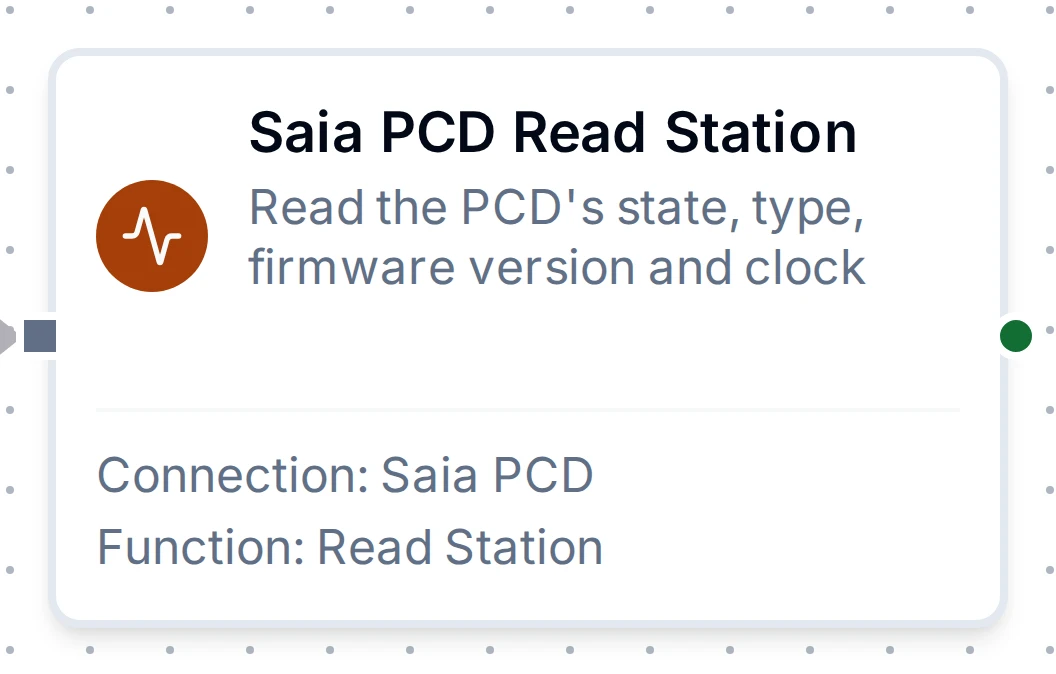
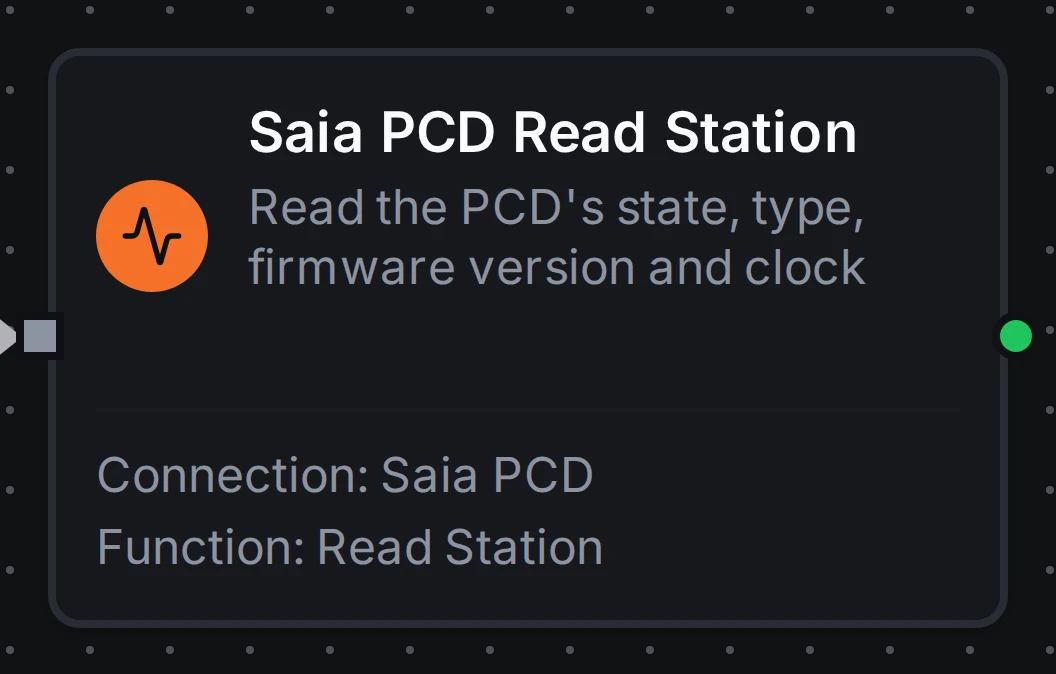
Saia PCD Read Station Node
Supported Function Types:
| Node | Function | Purpose | Common Use Cases |
|---|---|---|---|
Saia PCD Read Station (connected.saia.read.station) | saia.read.station | Read the PCD's state, type, firmware version and clock | Checking that a PCD runs before writing to it, an inventory of firmware versions, clock drift |
The node reads what the PCD says about itself, in four short telegrams. See Read Station.
Output Structure
{
  "result": {
    "state": "run",
    "station": 10,
    "pcdType": "D2M48",
    "firmwareVersion": "020",
    "clock": "2026-11-15 10:06:58"
  }
}
| Key | Meaning |
|---|---|
result.state | The state of the PCD's CPU: run, stop, halt, or the letter the PCD reports for another state |
result.station | The S-Bus station number the PCD reports |
result.pcdType | The PCD type, as the PCD reports it: D2M48 is a PCD2.M48x, D1M22 a PCD1.M22x |
result.firmwareVersion | The firmware version, as the PCD reports it |
result.clock | The PCD's real-time clock: its local date and time, as it keeps it, without a time zone. Present only when the PCD answers the clock read: one without a real-time clock refuses it, and the rest is still reported |
Check that a PCD runs with $node["PCD State"].result.state in a Condition node.
Errors
| Error | Meaning | Retried by the node settings? |
|---|---|---|
no answer from station n … | No answer to any attempt: the PCD is off or out of reach, or the station number is not its own | Yes. A write sent again leaves the PCD in the same state as one write of the same values |
station n refused the request: NAK 1, no reason given … | The PCD refused the request, for example an address it does not have | No: the result is permanent |
station n refused the request: NAK 2 or NAK 3 | A password, or a port in reduced protocol | No |
station n refused the request: NAK 4, the PGU port is already in use | Another client holds the PCD's PGU port | Yes |
| A refusal before anything is sent (an address that is no address, a data type the medium does not hold, a write to an input, a data block or a bit inside a register, a float with no FFP form, a list too long for one telegram) | MaestroHub refused the request; nothing reached the PCD | No |
not connected to the PCD | The connection is down | Yes |
The full list of messages, with what to change for each, is in the guide's Troubleshooting.
Settings Tab
All Saia PCD node types share the same Settings tab:
| Setting | Type | Default | Description |
|---|---|---|---|
| Description | Text | - | Optional description displayed on the node |
| Timeout (seconds) | Number | Pipeline default | Maximum time the node may run before timing out |
| Retry on Timeout | Toggle | Pipeline default | Automatically retry the node if it times out |
| Retry on Fail | Toggle | Pipeline default | Automatically retry the node if it fails |
| On Error | Selection | Pipeline default | Error strategy: Pipeline Default (the pipeline's Error Handling setting), Stop Pipeline or Continue Execution |
When left at their defaults, these settings inherit from the pipeline-level execution configuration. The retry settings do not retry a request the PCD refused for the request itself (see Errors).
Use the Test button in the function form (on the connection page) to run every Saia PCD function against the live PCD before wiring it into a pipeline. It is the fastest way to catch a wrong station number, an address the PCD does not have, or the wrong float format.