Brother TC Nodes
Read a Brother TC machine's state, program, alarms, work counters, tool life and PLC devices from a pipeline, and write its PLC devices.
- Operations
- Read Device · Read Block · Write Device
- Requests
- One per PLC device, one per CNC file
- Writes
- Y, M, LM, D, LD; never buffered
Use Brother TC machines in pipelines. Each function authored on a Brother TC connection is available as a matching node in the Pipeline Designer: Brother TC Read Device, Brother TC Read Block and Brother TC Write Device.
For connection setup, the PLC areas and the CNC signals, see the Brother TC connection guide.
A Brother machine does not send data on its own, so there is no trigger node: to poll one, drive the reads from a Schedule trigger.
Configuration Quick Reference
| Field | What you choose | Details |
|---|---|---|
| Parameters | Connection, Function, Function Parameters, Timeout Override | Select the Brother TC connection, pick a function, bind parameters with expression support, and optionally override the timeout. |
| Settings | Description, Timeout (seconds), Retry on Timeout, Retry on Fail, On Error | Node description, maximum execution time, retry behaviour and error strategy. All execution settings default to pipeline-level values. |
Every node shares the same Parameters: Connection (the Brother TC connection profile), Function (a function of the node's type on that connection), Function Parameters (auto-populated from the function schema, with expression syntax {{ expression }} for dynamic values) and an optional Timeout Override in seconds. Each node receives the output of the previous node as input, which function parameter expressions can reference as $input.
The call's own facts ride along under _metadata next to the four every connected node carries. Every Brother TC node delivers _metadata.method (the operation that ran, e.g. brothertc.read.device), _metadata.connectionId (the connection it ran over) and _metadata.protocol (brothertc).
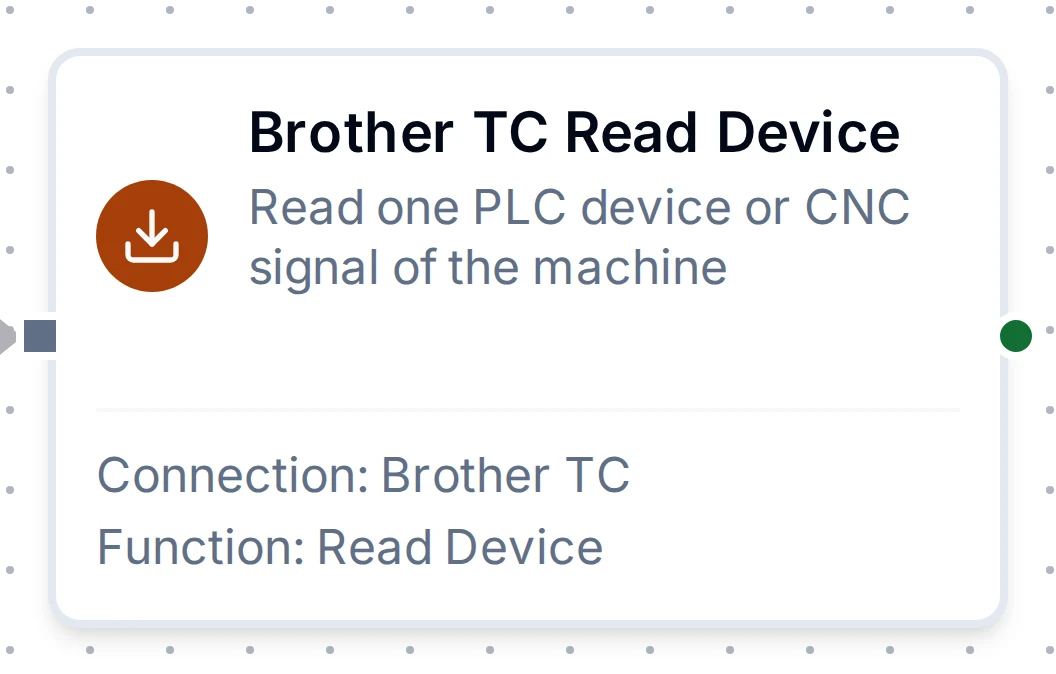
Read Device node
Brother TC Read Device Node
Supported Function Types:
| Node | Function | Purpose | Common Use Cases |
|---|---|---|---|
Brother TC Read Device (connected.brothertc.read.device) | brothertc.read.device | Read one PLC device or CNC signal of the machine | The running program on a schedule, a part counter, a PLC register |
The node reads the device or signal the function names. The address decides the value's type: a PLC bit is true or false, a PLC word a number from -32768 to 32767, RUNNING is true or false, and every other signal a number. See Read Device and Addresses.
Output Structure
{
  "result": {
    "device": "PROGRAMNUMBER",
    "value": 1234,
    "quality": "good"
  }
}
| Key | Meaning |
|---|---|
result.device | The device or signal read, upper-cased: y1f comes back as Y1F |
result.value | The value: true/false for a PLC bit and for RUNNING, a number for a PLC word and for every other signal |
result.quality | good. A value the machine did not give fails the node instead of storing one, so a value that reached the result is the machine's own |
Read a value with $node["Read Program"].result.value.
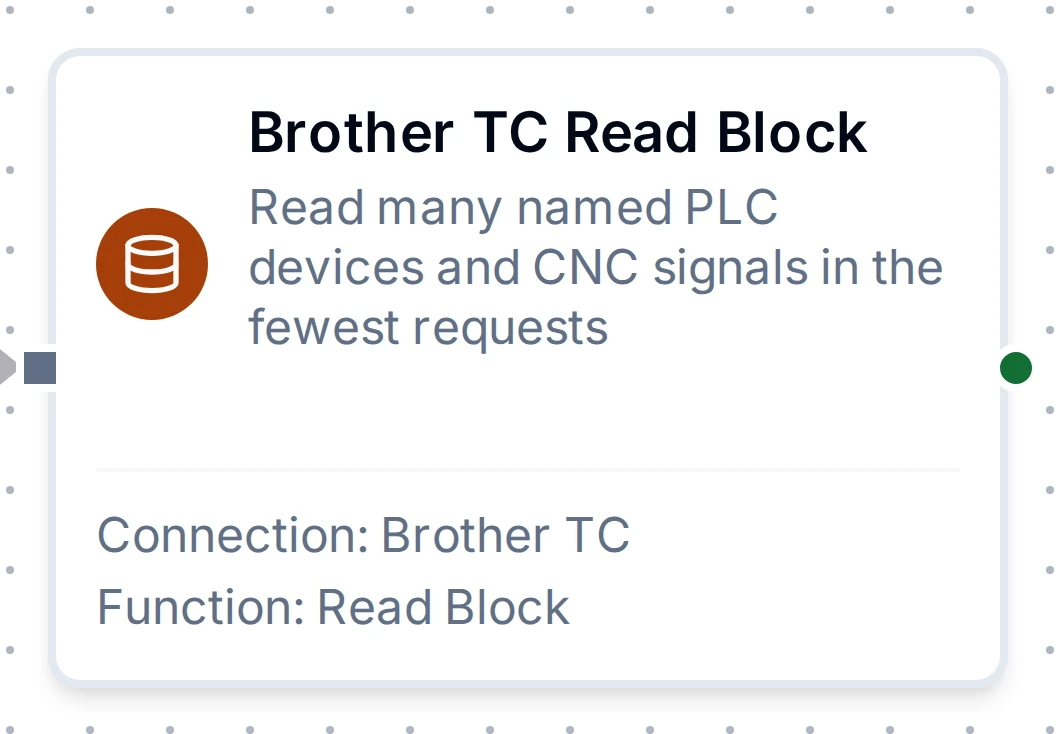
Read Block node
Brother TC Read Block Node
Supported Function Types:
| Node | Function | Purpose | Common Use Cases |
|---|---|---|---|
Brother TC Read Block (connected.brothertc.read.block) | brothertc.read.block | Read many named PLC devices and CNC signals in the fewest requests | A machine's state, program, alarms, part count and tool life in one node |
The node reads every point of the function and returns each value by its name. Each CNC file (MEM for the state and the alarms, WKCNTR for the work counters, TOLNM0 to TOLNM9 for each tool group) is read once however many of its signals are listed, and each PLC device takes one request. A point the machine does not give is reported by name without failing the others; the node fails only when the link fails. See Read Block.
Output Structure
When every point was read:
{
  "result": {
    "count": 3,
    "values": { "Running": true, "Program": 1234, "Parts": 120 },
    "quality": "good",
    "totalDataPoints": 3,
    "totalReads": 2
  }
}
Here Running and Program share one read of the MEM file, and Parts (COUNTER:A:1:COUNT) takes one read of WKCNTR.
When a point was not read, it is missing from values, its reason is in errors under its name, and quality is bad:
{
  "result": {
    "count": 2,
    "values": { "Running": true, "Parts": 120 },
    "errors": {
      "Spare": "brother: the machine's WKCNTR file has no B04 record"
    },
    "quality": "bad",
    "totalDataPoints": 3,
    "totalReads": 2
  }
}
| Key | Meaning |
|---|---|
result.values | Every point that was read, by its name |
result.errors | The reason for each point that was not read, by its name. Present only when a point was not read |
result.count | How many points were read |
result.totalDataPoints | How many points were requested |
result.totalReads | How many requests were sent: one per PLC device and one per CNC file |
result.quality | good when every point was read, bad when one was not |
Read a point with $node["Machine Status"].result.values.Running. Check $node["Machine Status"].result.errors before relying on every point being present.
Write Device node
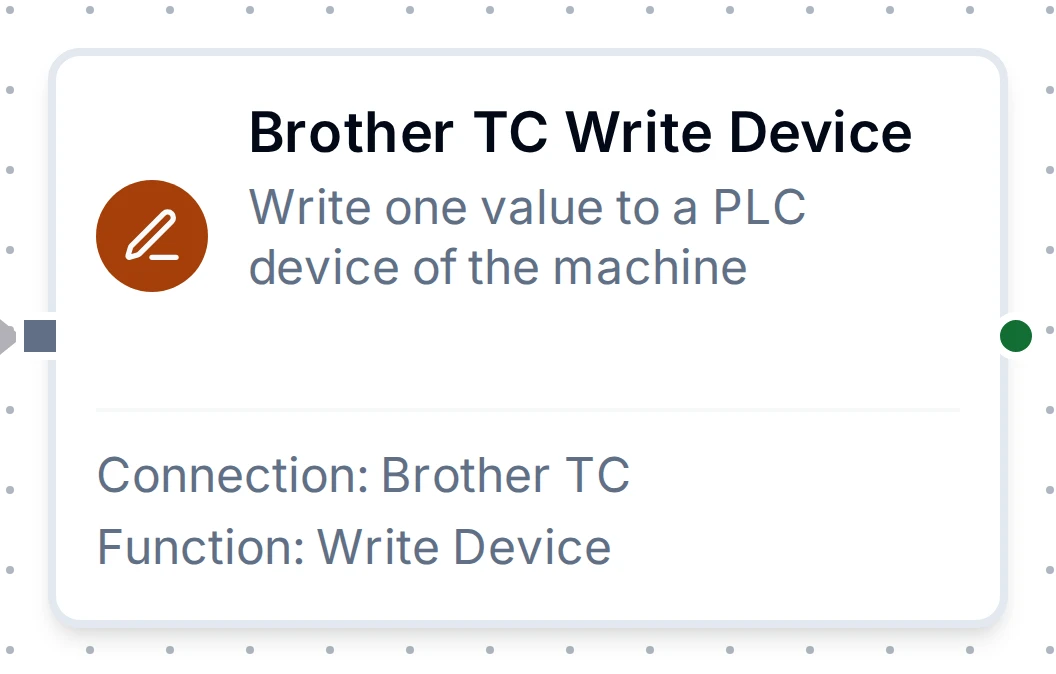
Brother TC Write Device Node
Supported Function Types:
| Node | Function | Purpose | Common Use Cases |
|---|---|---|---|
Brother TC Write Device (connected.brothertc.write.device) | brothertc.write.device | Write one value to a PLC device of the machine | A setpoint register, a request relay the ladder program reads |
The node writes one value to one PLC device in one request: a bit of Y, M or LM, or a signed 16-bit word of D or LD. X, BX, BY, BDX, BDY and every CNC signal are read only. See Write Device.
A write is never buffered for later delivery, and it is refused in a run started by a late (replayed) input unless the node allows late input. A value that does not fit its device, or a read-only device, fails the node before anything is sent to the machine.
Output Structure
{
  "result": {
    "device": "D100",
    "value": "250"
  }
}
| Key | Meaning |
|---|---|
result.device | The device written, upper-cased |
result.value | The value as given, after parameter substitution |
A write whose answer did not come is reported as outcome unknown, because it may have reached the machine. Writing a value again leaves the device as one write did, so the write is declared safe to repeat, and the node's Retry on Fail and Retry on Timeout send it again (see A write whose outcome is unknown is sent again only when that is safe). For a relay the ladder program sets a sequence going with and then clears, a second write can start the sequence twice: turn Retry on Fail and Retry on Timeout off on that node.
Always validate values in a Condition node before writing to a machine's PLC. Its ladder program acts on the new value at once.
Errors
| Error | Meaning | Retried by the node settings? |
|---|---|---|
| A refusal before anything is sent (an address that is no address, a device past its area, a write to a read-only device or a CNC signal, a value that does not fit) | MaestroHub refused the request; nothing reached the machine | No |
the machine's <file> file has no <record> record | The machine answered without the counter or tool asked for | No |
the machine answered … with completion code NN | The machine answered with a code other than 00; what it means is not documented | Yes |
no answer from the machine, or the connection closed after the request was sent | The request was sent and its answer did not come; the connection is opened again. A read is transient; a write's outcome is unknown, because it may have reached the machine | A read: yes. A write: yes, as outcome unknown; it is safe to repeat |
the machine's data cannot be read | The machine answered with data of the wrong shape. For a write, an acknowledgement that carries data: whether the value was written is not known | A read: yes. A write: yes, as outcome unknown; it is safe to repeat |
not connected | The connection is down | Yes |
The full list, with what to change for each, is in the guide's Troubleshooting.
Settings Tab
All Brother TC node types share the same Settings tab:
| Setting | Type | Default | Description |
|---|---|---|---|
| Description | Text | - | Optional description displayed on the node |
| Timeout (seconds) | Number | Pipeline default | Maximum time the node may run before timing out |
| Retry on Timeout | Toggle | Pipeline default | Automatically retry the node if it times out |
| Retry on Fail | Toggle | Pipeline default | Automatically retry the node if it fails |
| On Error | Selection | Pipeline default | Error strategy: Pipeline Default (the pipeline's Error Handling setting), Stop Pipeline or Continue Execution |
When left at their defaults, these settings inherit from the pipeline-level execution configuration. The retry settings do not retry a request refused before it was sent, or a counter or tool the machine does not have (see Errors).
Use the Test button in the function form (on the connection page) to run every Brother TC function against the machine before wiring it into a pipeline. It is the fastest way to catch a counter or tool the machine does not have.