JTEKT TOYOPUC Nodes
Read and write data registers, relays, inputs and outputs, program registers and extended areas on TOYOPUC PLCs from a pipeline.
- Operations
- Read Device · Read Block · Write Device
- Limits
- 256 registers per block request
- Writes
- Bits set by the PLC itself; never buffered
Use JTEKT TOYOPUC PLCs in pipelines. Each function authored on a JTEKT TOYOPUC connection is available as a matching node in the Pipeline Designer: JTEKT TOYOPUC Read Device, JTEKT TOYOPUC Read Block and JTEKT TOYOPUC Write Device.
For connection setup (TCP or UDP, the PLC models, the relay path), the address forms and the data types, see the JTEKT TOYOPUC connection guide.
A TOYOPUC does not send data on its own, so there is no trigger node: to poll one, drive the reads from a Schedule trigger.
Configuration Quick Reference
| Field | What you choose | Details |
|---|---|---|
| Parameters | Connection, Function, Function Parameters, Timeout Override | Select the JTEKT TOYOPUC connection, pick a function, bind parameters with expression support, and optionally override the timeout. |
| Settings | Description, Timeout (seconds), Retry on Timeout, Retry on Fail, On Error | Node description, maximum execution time, retry behaviour and error strategy. All execution settings default to pipeline-level values. |
Every node shares the same Parameters: Connection (the JTEKT TOYOPUC connection profile), Function (a function of the node's type on that connection), Function Parameters (auto-populated from the function schema, with expression syntax {{ expression }} for dynamic values) and an optional Timeout Override in seconds. Each node receives the output of the previous node as input, which function parameter expressions can reference as $input.
The call's own facts ride along under _metadata next to the four every connected node carries. Every JTEKT TOYOPUC node delivers _metadata.method (the operation that ran, e.g. toyopuc.read.device), _metadata.connectionId (the connection it ran over) and _metadata.protocol (toyopuc).
Read Device node
JTEKT TOYOPUC Read Device Node
Supported Function Types:
| Node | Function | Purpose | Common Use Cases |
|---|---|---|---|
JTEKT TOYOPUC Read Device (connected.toyopuc.read.device) | toyopuc.read.device | Read one typed value, or a run of consecutive values, from a device address | A production count on a schedule, an internal relay, a register of one program |
The node reads the device the function names as its data type, or Count consecutive values. Bits are read in the words that hold them; nothing is written. See Read Device for the parameters and Device Addresses for the address forms.
Output Structure
{
  "result": {
    "device": "D0100",
    "dataType": "DINT",
    "value": 1234,
    "quality": "good"
  }
}
With Count more than 1, value is a list:
{
  "result": {
    "device": "M0010",
    "dataType": "BIT",
    "value": [true, false, false, true],
    "quality": "good"
  }
}
| Key | Meaning |
|---|---|
result.device | The device read, in one standard form: d100 comes back as D0100, p2-d100 as P2-D0100, m1w as M001W |
result.dataType | The type the value was decoded as: BIT, WORD, INT, DWORD, DINT, REAL, LREAL or STRING |
result.value | The decoded value: a number, true/false for a bit, text for a STRING. A list of values when Count is more than 1 |
result.quality | good. A refusal by the PLC fails the node instead of storing a value, so a value that reached the result is the PLC's own reading |
Read a value with $node["Read Count"].result.value, and the third of a list with $node["Read Counts"].result.value[2].
Read Block node
JTEKT TOYOPUC Read Block Node
Supported Function Types:
| Node | Function | Purpose | Common Use Cases |
|---|---|---|---|
JTEKT TOYOPUC Read Block (connected.toyopuc.read.block) | toyopuc.read.block | Read many named, typed devices in the fewest requests | A line's counts, setpoints and alarm bits in one node |
The node reads every point of the function and returns each value by its name. Neighbouring devices are merged into one block read, and scattered ones into one multi-point read, where they fit. A device the PLC refuses, or one the connection's PLC model does not have, is reported by name without failing the others; the node fails only when the link fails. See Read Block for the parameters and how points are merged.
Output Structure
When every point was read:
{
  "result": {
    "count": 3,
    "values": { "Count": 1234, "Scrap": 3, "Alarm": true },
    "quality": "good",
    "totalDataPoints": 3,
    "totalReads": 2
  }
}
Here Count (D0100 as DINT) and Scrap (D0102) share one block read, and Alarm (P1-M0010) takes a second request.
When a point was not read, it is missing from values, its reason is in errors under its name, and quality is bad:
{
  "result": {
    "count": 2,
    "values": { "Count": 1234, "Alarm": true },
    "errors": {
      "Spare": "toyopuc: D3000: a PC10G PC10 mode reaches D0000 to D2FFF"
    },
    "quality": "bad",
    "totalDataPoints": 3,
    "totalReads": 1
  }
}
Here Spare is D3000 on a connection whose model is pc10g-pc10, which reaches D0000 to D2FFF: it is refused before anything is sent, and Count (D0100) and Alarm (M0010) are read in one request. When the PLC itself refuses a request that carries several points, each of them is asked for on its own, so the others still arrive, and totalReads counts those requests too.
| Key | Meaning |
|---|---|
result.values | Every point that was read, by its name |
result.errors | The reason for each point that was not read, by its name. Present only when a point was not read |
result.count | How many points were read |
result.totalDataPoints | How many points were requested |
result.totalReads | How many requests the points were merged into, including the requests that asked again point by point after a refusal |
result.quality | good when every point was read, bad when one was not |
Read a point with $node["Line Status"].result.values.Alarm. Check $node["Line Status"].result.errors before relying on every point being present.
Write Device node
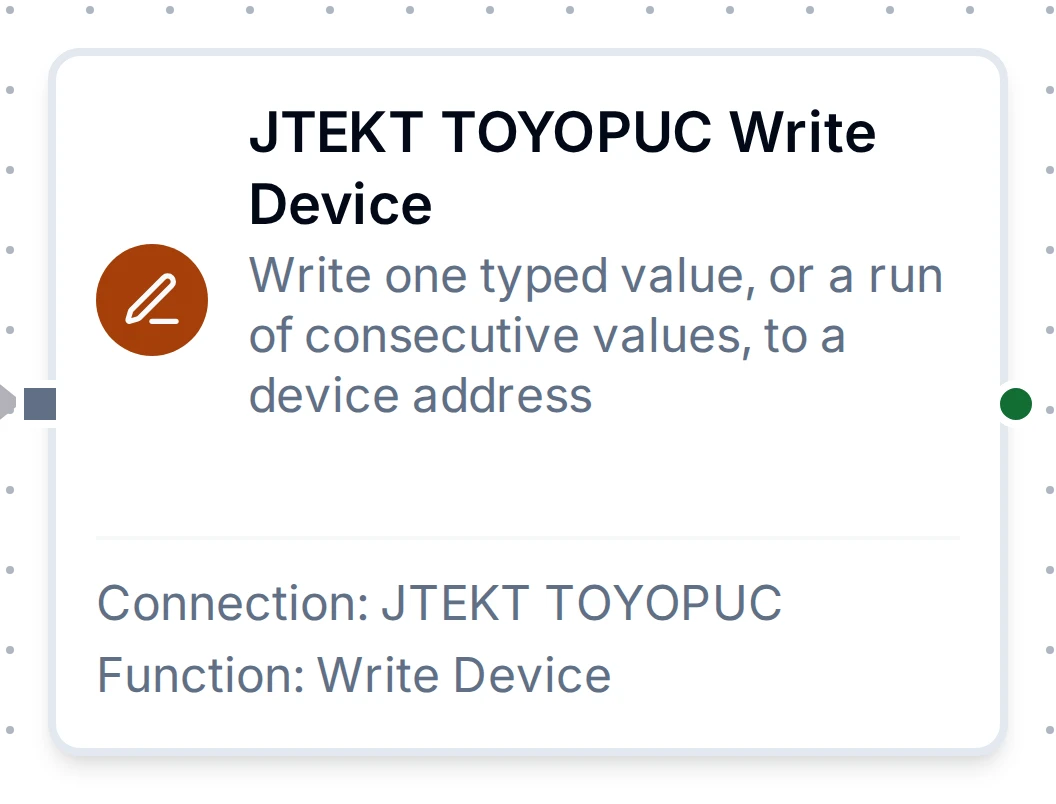
JTEKT TOYOPUC Write Device Node
Supported Function Types:
| Node | Function | Purpose | Common Use Cases |
|---|---|---|---|
JTEKT TOYOPUC Write Device (connected.toyopuc.write.device) | toyopuc.write.device | Write one typed value, or a run of consecutive values, to a device address | Setpoints, recipes, alarm acknowledgement and control relays |
The node writes the function's value, or a list of values to consecutive registers in one request. A bit is set or reset by the PLC itself with its bit-write command, so bits the program changes in the same word are never overwritten. Several bits of a basic area (an address without P1- to P3-) are written one bit write each, in order, and a failure part way says how many were written. FR is read only. See Write Device for the parameters and the write rules.
A write is never buffered for later delivery, and it is refused in a run started by a late (replayed) input unless the node allows late input. A value that does not fit its device fails the node before anything is sent to the PLC.
Output Structure
{
  "result": {
    "device": "D0200",
    "dataType": "REAL",
    "value": "72.5"
  }
}
| Key | Meaning |
|---|---|
result.device | The device written, in one standard form: d200 comes back as D0200, m1w as M001W |
result.dataType | The type the value was encoded as |
result.value | The value as given, after parameter substitution: "72.5", or the list "[120, 45, 3]" |
Always validate values in a Condition node before writing to a PLC. A setpoint or a bit can move a motor, valve or actuator immediately.
Errors
| Error | Meaning | Retried by the node settings? |
|---|---|---|
the PLC refused the request: … naming the address, the count, the command or a protection (error codes 40, 41, 23, 34, 31 and the others the guide lists as not retried) | The PLC refused the request, with its own reason and error code | No: the result is permanent |
the PLC refused the request: a competing process prevents it (3D), the PLC is being reset (3E), relay commands collided on the same link module; retry (73) | The PLC or a link module is busy for now | Yes |
hop … of the relay path (…) refused the request: … | A hop of the relay path did not pass the request on, or the PLC behind it refused it | As its error code |
A refusal before anything is sent (an address that is no address, a device the PLC model does not have, a value that does not fit, a write to FR, a list too long for one request) | MaestroHub refused the request; nothing reached the PLC | No |
no answer from the PLC | The request was sent and not answered within the connection's Response Timeout | Yes. A write sent again leaves the PLC in the same state as one write of the same value |
not connected | The connection is down | Yes |
The full list of codes and messages, with what to change for each, is in the guide's Troubleshooting.
Settings Tab
All JTEKT TOYOPUC node types share the same Settings tab:
| Setting | Type | Default | Description |
|---|---|---|---|
| Description | Text | - | Optional description displayed on the node |
| Timeout (seconds) | Number | Pipeline default | Maximum time the node may run before timing out |
| Retry on Timeout | Toggle | Pipeline default | Automatically retry the node if it times out |
| Retry on Fail | Toggle | Pipeline default | Automatically retry the node if it fails |
| On Error | Selection | Pipeline default | Error strategy: Pipeline Default (the pipeline's Error Handling setting), Stop Pipeline or Continue Execution |
When left at their defaults, these settings inherit from the pipeline-level execution configuration. The retry settings do not retry a request the PLC refused for its address, its count, its command or a protection (see Errors).
Use the Test button in the function form (on the connection page) to run every JTEKT TOYOPUC function against the live PLC before wiring it into a pipeline. It is the fastest way to catch a wrong PLC model, a device the model does not reach, or an upper range written without its program prefix.