GE SRTP Nodes
Read and write registers, analog I/O and discrete memory of GE and Emerson PLCs from a pipeline.
- Operations
- Read Device · Read Block · Write Device · Write Register Bit
- Limits
- Max Request Size per request (2040 bytes by default)
- Writes
- Never buffered; a register bit sent at most once
Use GE and Emerson PLCs in pipelines. Each function authored on a GE SRTP connection is available as a matching node in the Pipeline Designer: GE SRTP Read Device, GE SRTP Read Block, GE SRTP Write Device and GE SRTP Write Register Bit.
For connection setup (the CPU slot, the request size), the reference forms and the data types, see the GE SRTP connection guide.
A GE PLC does not send SRTP data on its own, so there is no trigger node: to poll one, drive the reads from a Schedule trigger.
Configuration Quick Reference
| Field | What you choose | Details |
|---|---|---|
| Parameters | Connection, Function, Function Parameters, Timeout Override | Select the GE SRTP connection, pick a function, bind parameters with expression support, and optionally override the timeout. |
| Settings | Description, Timeout (seconds), Retry on Timeout, Retry on Fail, On Error | Node description, maximum execution time, retry behaviour and error strategy. All execution settings default to pipeline-level values. |
Every node shares the same Parameters: Connection (the GE SRTP connection profile), Function (a function of the node's type on that connection), Function Parameters (auto-populated from the function schema, with expression syntax {{ expression }} for dynamic values) and an optional Timeout Override in seconds. Each node receives the output of the previous node as input, which function parameter expressions can reference as $input.
The call's own facts ride along under _metadata next to the four every connected node carries. Every GE SRTP node delivers _metadata.method (the operation that ran, e.g. gesrtp.read.device), _metadata.connectionId (the connection it ran over) and _metadata.protocol (gesrtp).
Read Device node
GE SRTP Read Device Node
Supported Function Types:
| Node | Function | Purpose | Common Use Cases |
|---|---|---|---|
GE SRTP Read Device (connected.gesrtp.read.device) | gesrtp.read.device | Read one typed value, or a run of consecutive values, from a GE reference | A production count on a schedule, an analog input, an internal coil |
The node reads the reference the function names as its data type, or Count consecutive values. See Read Device for the parameters and References for the reference forms.
Output Structure
{
  "result": {
    "device": "%R100",
    "dataType": "DINT",
    "value": 1234,
    "quality": "good"
  }
}
With Count more than 1, value is a list:
{
  "result": {
    "device": "%M17",
    "dataType": "BIT",
    "value": [true, false, false, true],
    "quality": "good"
  }
}
| Key | Meaning |
|---|---|
result.device | The reference read, in GE's form: r00100 comes back as %R100 |
result.dataType | The type the value was decoded as: BIT, USINT, WORD, INT, DWORD, DINT, REAL or LREAL |
result.value | The decoded value: a number, or true/false for a bit. A list of values when Count is more than 1 |
result.quality | good. A refusal by the PLC fails the node instead of storing a value, so a value that reached the result is the PLC's own reading |
Read a value with $node["Read Count"].result.value, and the third of a list with $node["Read Counts"].result.value[2].
Read Block node
GE SRTP Read Block Node
Supported Function Types:
| Node | Function | Purpose | Common Use Cases |
|---|---|---|---|
GE SRTP Read Block (connected.gesrtp.read.block) | gesrtp.read.block | Read many named, typed references in the fewest requests | A line's counts, analog values and alarm coils in one node |
The node reads every point of the function and returns each value by its name. References of the same memory that lie close together are merged into one request. A reference the PLC refuses is reported by name without failing the others; the node fails only when the link fails. See Read Block for the parameters and how points are merged.
Output Structure
When every point was read:
{
  "result": {
    "count": 3,
    "values": { "Count": 1234, "Scrap": 3, "Running": true },
    "quality": "good",
    "totalDataPoints": 3,
    "totalReads": 2
  }
}
Here Count (%R100 as DINT) and Scrap (%R102) share one request, and Running (%M17) takes a second.
When a point was not read, it is missing from values, its reason is in errors under its name, and quality is bad:
{
  "result": {
    "count": 2,
    "values": { "Count": 1234, "Running": true },
    "errors": {
      "Spare": "gesrtp: the PLC refused the request: service request error (major 0x05, minor 0xF9: task address out of range); the reference may not exist on this PLC, or lie past the end of its memory"
    },
    "quality": "bad",
    "totalDataPoints": 3,
    "totalReads": 4
  }
}
Here the PLC has 2048 registers, Count is %R2040 and Spare is %R2050, past the end. They shared a request, so after the refusal each of the two was asked for on its own, and totalReads counts those requests too: the shared one, the two single ones and the one for Running.
| Key | Meaning |
|---|---|
result.values | Every point that was read, by its name |
result.errors | The reason for each point that was not read, by its name. Present only when a point was not read |
result.count | How many points were read |
result.totalDataPoints | How many points were requested |
result.totalReads | How many requests the points were merged into, including the requests that asked again point by point after a refusal |
result.quality | good when every point was read, bad when one was not |
Read a point with $node["Line Status"].result.values.Running. Check $node["Line Status"].result.errors before relying on every point being present.
Write Device node
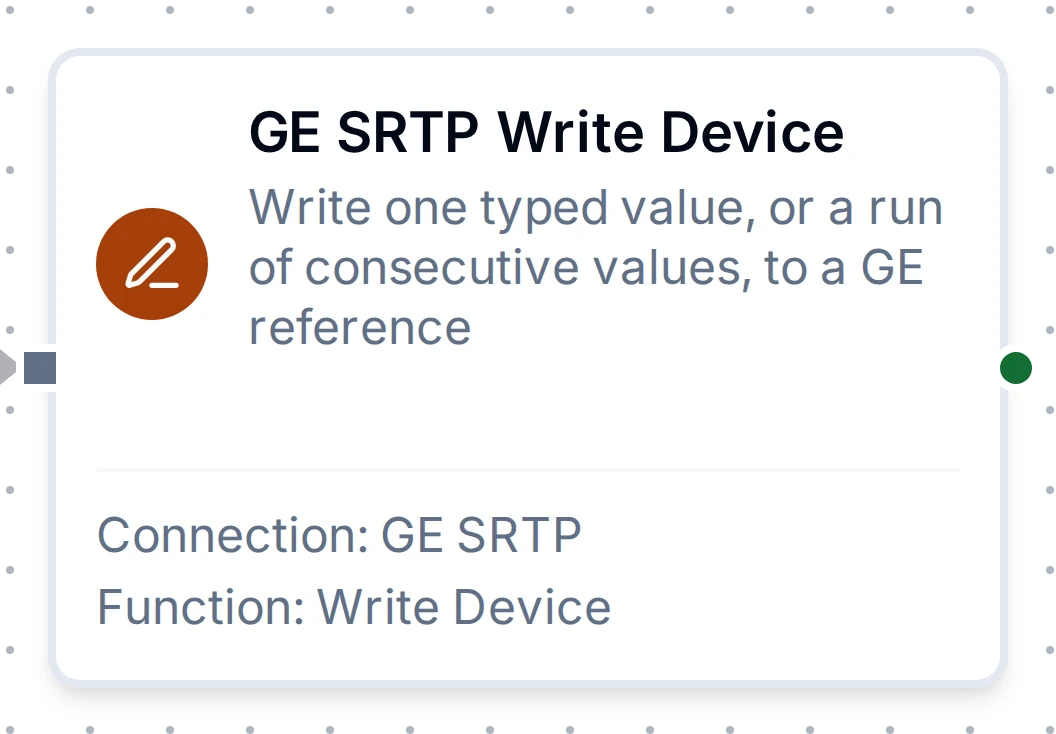
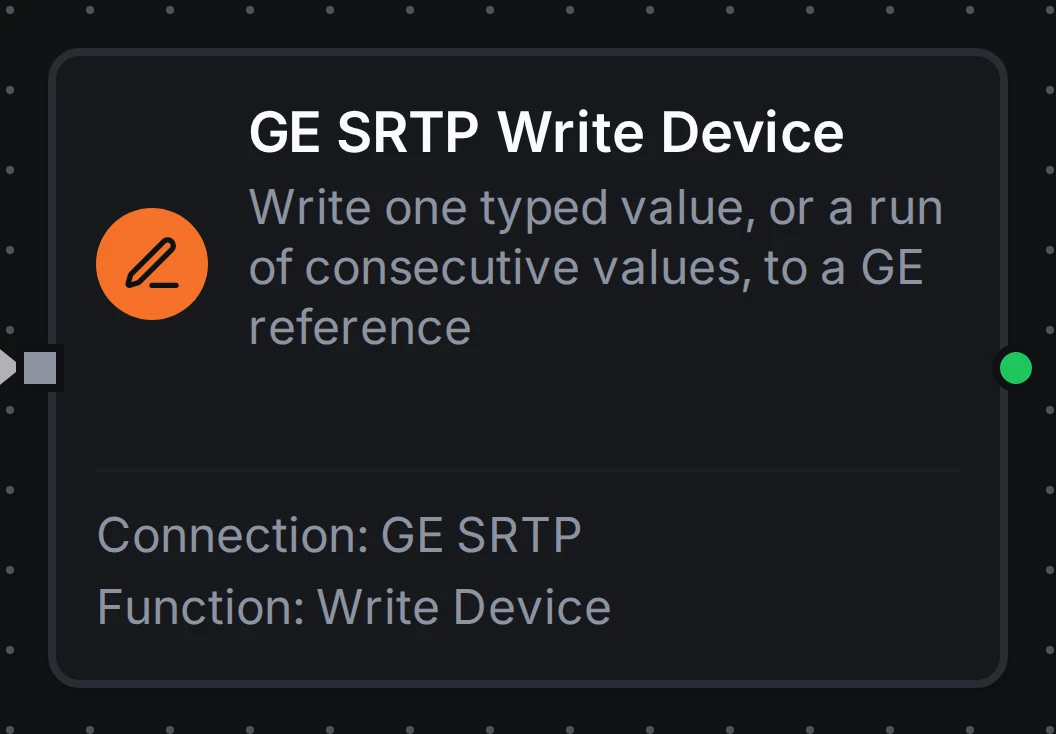
GE SRTP Write Device Node
Supported Function Types:
| Node | Function | Purpose | Common Use Cases |
|---|---|---|---|
GE SRTP Write Device (connected.gesrtp.write.device) | gesrtp.write.device | Write one typed value, or a run of consecutive values, to a GE reference | Setpoints, recipes, control coils |
The node writes the function's value, or a list of values to consecutive references in one request. One discrete bit is set or reset by the PLC itself. %S is read only, and a bit of a register is written with Write Register Bit. See Write Device for the parameters and the write rules.
A write is never buffered for later delivery, and it is refused in a run started by a late (replayed) input unless the node allows late input. A value that does not fit its reference fails the node before anything is sent to the PLC.
Output Structure
{
  "result": {
    "device": "%R200",
    "dataType": "REAL",
    "value": "72.5"
  }
}
| Key | Meaning |
|---|---|
result.device | The reference written, in GE's form |
result.dataType | The type the value was encoded as |
result.value | The value as given, after parameter substitution: "72.5", or the list "[120, 45, 3]" |
Write Register Bit node
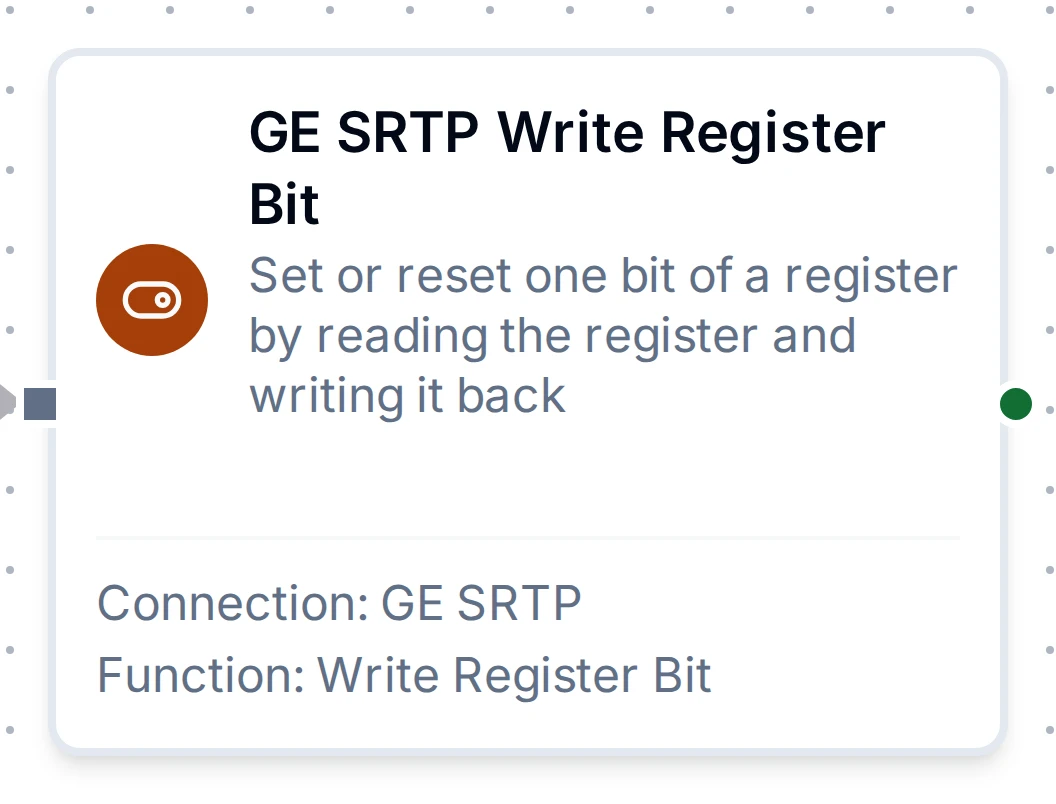
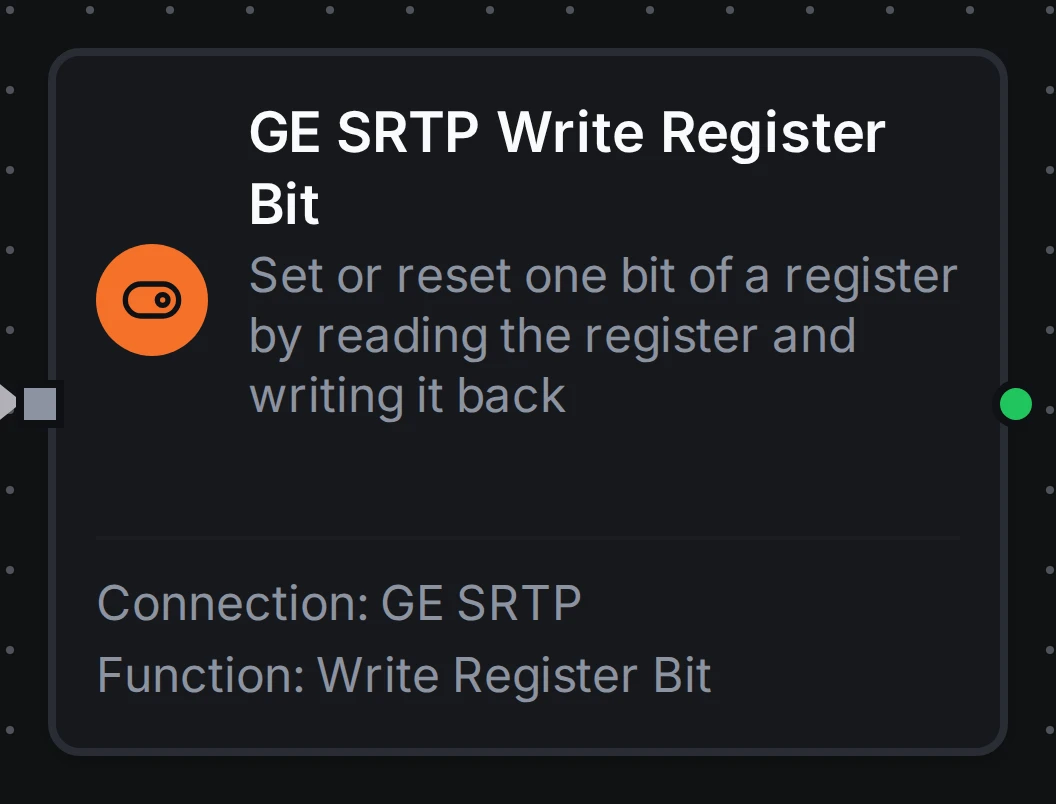
GE SRTP Write Register Bit Node
Supported Function Types:
| Node | Function | Purpose | Common Use Cases |
|---|---|---|---|
GE SRTP Write Register Bit (connected.gesrtp.write.bit) | gesrtp.write.bit | Set or reset one bit of a register by reading the register and writing it back | Handshake and request bits kept in a register |
SRTP writes whole registers, so the node reads the register, changes the bit and writes the register back. A bit the PLC program changes in that register between the two is overwritten. See Write Register Bit.
The node is a control command: it is never buffered, and when its outcome is unknown it is never sent again, whatever Retry on Fail or a ForEach retry says. A failure says COMMAND_REFUSED when the result is permanent: the PLC refused the request for its reference or the privilege level, the register read brought no data, or MaestroHub refused it before sending. It says COMMAND_OUTCOME_UNKNOWN otherwise: no answer to the write (it may have been carried out), or a refusal that describes a passing state (a busy PLC). COMMAND_OUTCOME_UNKNOWN also appears when nothing was sent: when the register read before the write gets no answer, or the run ends between the read and the write. Then the connector's message, the register was not written: …, is the authoritative one: nothing was written. (A separate code for a command that was never sent is tracked in #8765.)
Output Structure
{
  "result": {
    "device": "%R500.0",
    "value": true,
    "previous": 4,
    "written": 5
  }
}
| Key | Meaning |
|---|---|
result.device | The bit written, in GE's form |
result.value | The bit's new state |
result.previous | The register as it was read, before the bit was changed |
result.written | The register as it was written back |
Always validate values in a Condition node before writing to a PLC. A setpoint or a bit can move a motor, valve or actuator immediately.
Errors
| Error | Meaning | Retried by the node settings? |
|---|---|---|
the PLC refused the request: … with major 0x01, 0x02, 0x05 or 0x06 | The PLC refused the request for its reference, its size or the privilege level | No: the result is permanent |
the PLC refused the request: … with major 0x04 or 0x07, or without a code | The PLC is busy or received a request out of order | Yes, except Write Register Bit |
A refusal before anything is sent (a reference that is no reference, a type it does not hold, a value that does not fit, a write to %S, a write larger than one request) | MaestroHub refused the request; nothing reached the PLC | No |
no answer from the PLC | The request was sent and not answered within the connection's Response Timeout | Reads and Write Device: yes. Write Register Bit: never |
not connected | The connection is down | Yes |
The full list of codes and messages, with what to change for each, is in the guide's Troubleshooting.
Settings Tab
All GE SRTP node types share the same Settings tab:
| Setting | Type | Default | Description |
|---|---|---|---|
| Description | Text | - | Optional description displayed on the node |
| Timeout (seconds) | Number | Pipeline default | Maximum time the node may run before timing out |
| Retry on Timeout | Toggle | Pipeline default | Automatically retry the node if it times out |
| Retry on Fail | Toggle | Pipeline default | Automatically retry the node if it fails |
| On Error | Selection | Pipeline default | Error strategy: Pipeline Default (the pipeline's Error Handling setting), Stop Pipeline or Continue Execution |
When left at their defaults, these settings inherit from the pipeline-level execution configuration. The retry settings do not retry a request the PLC refused for its reference or its size, and never re-send a Write Register Bit (see Errors).
Use the Test button in the function form (on the connection page) to run every GE SRTP function against the live PLC before wiring it into a pipeline. It is the fastest way to catch a wrong CPU slot or a reference past the end of the PLC's memory.