Alstom Redundant Ethernet Integration Guide
Read and write Alstom controllers over up to four redundant Ethernet paths, with Redundant Modbus TCP.
- Status
- Beta
- Protocol
- Redundant Modbus TCP
- Transport
- TCP, one to four endpoints
- Operations
- Read Coils · Read Discrete Inputs · Read Holding Registers · Read Input Registers · Write Coils · Write Holding Registers
- Triggers
- None: poll with a Schedule trigger
Alstom controllers on a redundant control network speak Redundant Modbus TCP: an ordinary Modbus/TCP request, wrapped in a 12-byte Alstom header and sent at the same moment over up to four network paths. MaestroHub reads coils, discrete inputs, holding and input registers and writes coils and holding registers. It takes the first valid reply, drops the copies that arrive by the other paths, and never re-sends a write. This guide covers the paths, the station ID, the limits of one request, the six function types, and how the matching nodes fit into the Pipeline Designer.
What stands behind the connector today:
- The vendor driver's own logic. No public manual of the redundancy wrapper exists. Every byte MaestroHub puts around a Modbus request, and every check it makes on a reply, was read from a decompile of the vendor's driver, function by function.
- A real Modbus server behind the wrapper. An independent Modbus/TCP server (pymodbus, in a container) sits behind two simulated boards. MaestroHub's reads and writes of coils and registers, up to the largest request the Alstom core allows, agree with a plain Modbus client reading and writing the same server.
- A simulated controller with two boards and four paths, scripted to go silent, answer late, refuse, name the wrong station, repeat an old sequence number or send garbage.
What is not proven yet:
- It has not talked to a real Alstom controller. The redundancy wrapper is proven against the decompile and our own simulation, not against a board.
- What a board does with requests already in its receive buffer when a path is reset. MaestroHub drops what is still queued on its own side, but requests the board's network stack has already received may still be read by the board after the reset, depending on that stack. If they are, an old setpoint from a path whose board had stopped reading could reach the board after a newer one. The real-device check (#8737) covers it.
Overview
The Alstom Redundant Ethernet connector provides:
- Reads: coils (FC 01), discrete inputs (FC 02), holding registers (FC 03) and input registers (FC 04)
- Writes: coils (FC 15) and holding registers (FC 16), never re-sent
- Redundancy: one to four paths, every request sent on every open path at once; the first valid reply wins
- Duplicates dropped: the copies of an answer that arrive by the other paths are recognised by their transaction ID and sequence number and dropped
- Two networks: an optional local network card per pair of paths, for two separate control networks
- Register decoding: int16 to float64, strings, hex and bits, in any byte order, as the Modbus connector decodes them
Terms used in this guide
| Term | Meaning |
|---|---|
| Path | One TCP connection from MaestroHub to one controller endpoint (an IPv4 address and a port). Up to four. |
| Group | Paths 1 and 3 form group A, paths 2 and 4 group B. The paths of a group share one sequence and one transaction counter: in a typical layout one group reaches one board of the controller over two networks. |
| Board ID | The ID a board puts in its replies. MaestroHub learns it from a path's first accepted reply and sends it back in that path's later requests. |
| Station ID | The controller's station address. Every request names it, and a reply that names another station is refused. |
| Sequence number | A number each side puts in every frame. A reply is taken only when its number moves forward, which is how the second copy of an answer is told apart. |
Not supported
| What | Why |
|---|---|
| Writing one bit inside a register | It needs a read and then a write of the whole register, and with two boards the register can change in between. Write the whole register. |
| BCD, byte (high or low) and NUL-terminated string tags | The vendor's type table is not pinned down. Read the registers raw or as string, and convert in the pipeline. |
| Host names | The vendor driver takes IPv4 addresses only. |
| Read Group nodes | Not in this version. Use one function per block of registers. |
| Choosing between replies | A read is answered by the first reply that passes every check, as the vendor driver does: when that reply is a Modbus exception, the read fails with it even if another board would have answered with data. |
| A trigger, or MaestroHub acting as the controller | The controller does not send data on its own, and the vendor driver has no server mode. Poll with a Schedule trigger. |
What happens on connect
MaestroHub opens a TCP connection to every configured endpoint at once, each from its local interface when one is set. A path's connect waits a tenth of a second at most, as the vendor driver does. One open path is enough for the connection to come up; each path that did not open is named in a warning in the log. A path that did not open, or dropped later, is connected again in the background while another path carries the requests: a request starts that connect once the path has rested for at least a second, and the requests after it use the path again when it answers. No request waits for it.
A request is written to every open path at the same time, and each path's write gets a quarter of the Request Timeout (at least 20 ms, at most 100 ms, never more than the request has left). A board that stops reading does not block a write at once: the network buffers between MaestroHub and the board take many requests first, often megabytes, and only when they are full does a write wait. A path whose write waits out its time is closed, with a warning Alstom path dropped in the log, and connected again in the background like any dropped path; the other paths carry the request. The path is closed with a reset, so the requests still queued on MaestroHub's side are thrown away instead of reaching the board later, where an old setpoint could arrive after a newer one. Requests that already sit in the board's own receive buffer have left MaestroHub, and the board may still read them: whether a network stack hands them over after a reset depends on the stack (Linux does, Windows does not). Disconnecting closes every path plainly, as the vendor driver does, when no request is being written; when one is, it closes every path with a reset too.
When every path has dropped, the connection is lost: functions fail with not connected and the health check fails, until the connection connects again.
Connection Configuration
Creating an Alstom Redundant Ethernet Connection
Navigate to Connections → New Connection → Alstom Redundant Ethernet and fill in the form. It has four tabs: Connection, Functions, Scaling and Health. The Connection tab holds the profile, the paths and station, and the network and timing settings. The Functions, Scaling and Health tabs unlock after the connection is saved.
1. Profile Information
| Field | Default | Description |
|---|---|---|
| Profile Name | - | A descriptive name for this connection profile (required). Must be unique across all connections. |
| Description | - | Optional description for this connection |
| Labels | - | Key-value pairs to categorize and organize the connection |
2. Paths and Station
| Field | Default | Meaning |
|---|---|---|
| Path 1 Endpoint | - | IPv4 address and TCP port of the first path, for example 192.168.10.21:502 (group A, local interface 1) |
| Path 2 Endpoint | - | The second path (group B, local interface 1) |
| Path 3 Endpoint | - | The third path (group A, local interface 2) |
| Path 4 Endpoint | - | The fourth path (group B, local interface 2) |
| Station ID | (required) | The controller's station ID, 1 to 65535 |
Set at least one path. Every endpoint must be a unicast IPv4 address (not 0.0.0.0, broadcast or multicast) with a port from 1 to 65535, and no endpoint may appear twice. The port has no default: the vendor driver takes it from the configuration; 502, the Modbus port, is common.
The slot a path sits in matters: paths 1 and 3 share group A's sequence, paths 2 and 4 group B's. Put the two endpoints of one board in slots of the same group.
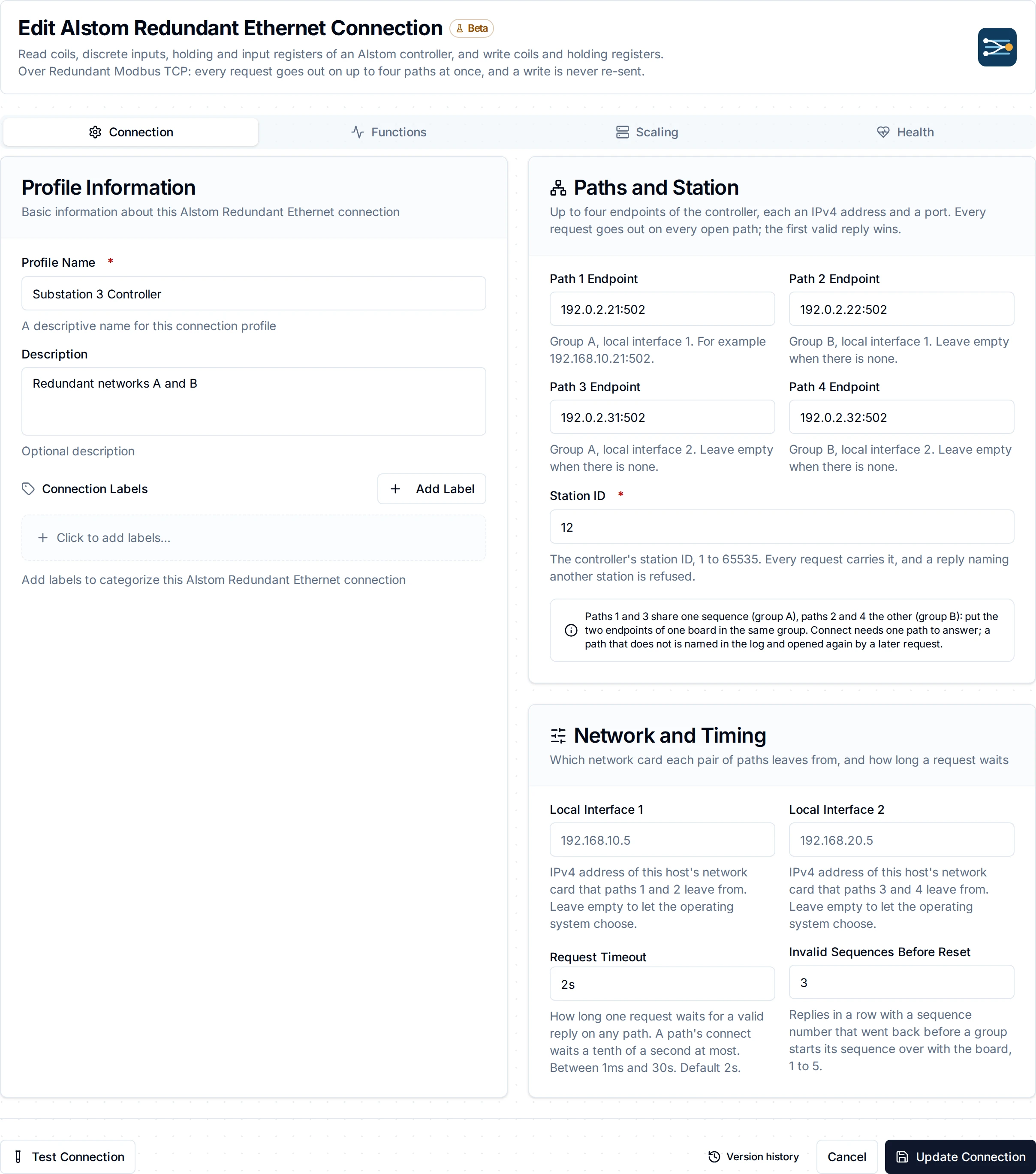
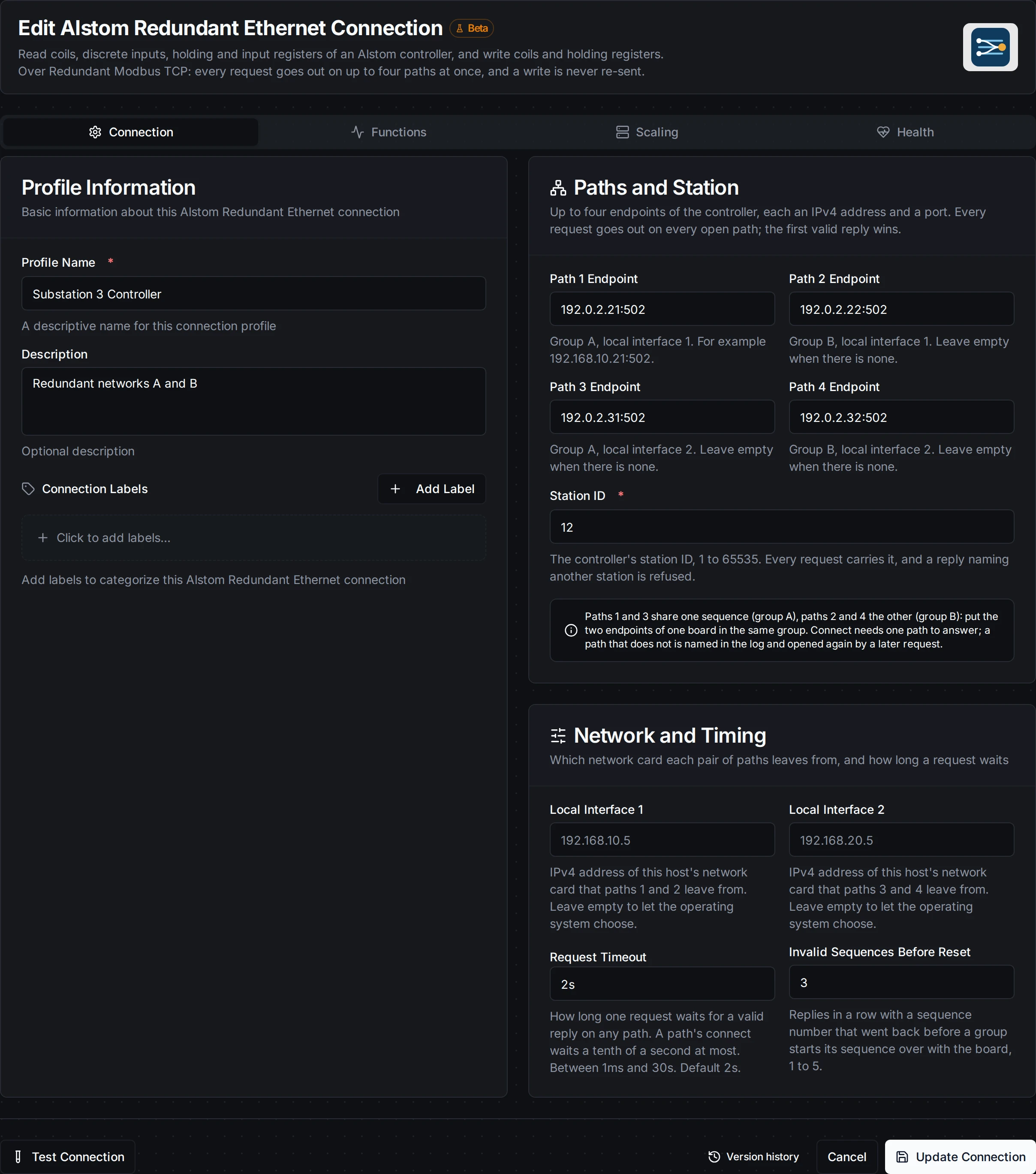
The Connection tab: up to four paths and the station ID
3. Network and Timing
| Field | Default | Meaning |
|---|---|---|
| Local Interface 1 | - | IPv4 address of this host's network card that paths 1 and 2 leave from. Empty: the operating system chooses |
| Local Interface 2 | - | The card paths 3 and 4 leave from |
| Invalid Sequences Before Reset | 3 | How many replies in a row whose sequence number went back a group takes before its sequence starts over with the board, 1 to 5 |
| Request Timeout | 2s | How long one request waits for a valid reply on any path, 1 ms to 30 s |
Each function also has its own Timeout (default 30m) that bounds the whole operation; the shorter of the two applies.
Testing the Connection
Click Test Connection at the bottom of the form to try the current settings before saving. Once the connection runs, its health check reads one coil at address 0 over every open path and reports the round trip. A refusal from the controller still proves a board answered. When no path answers, the connection is closed and opened again.
Security
Redundant Modbus TCP has no encryption and no authentication, like Modbus TCP. The station ID is an address, not a password. Keep the controller on a separate control network; the local interfaces let MaestroHub reach two redundant networks from two network cards.
Function Builder
Creating Alstom Redundant Ethernet Functions
After the connection is saved:
- Open the connection and navigate to the Functions tab
- Click New Function to open the function type selection dialog
- Choose one of the four reads or two writes
- Fill the Basic tab (name, description, labels) and the Configuration tab (operation-specific parameters)
- Use the Test button to run the function against the live controller before saving. Testing a write writes to the controller
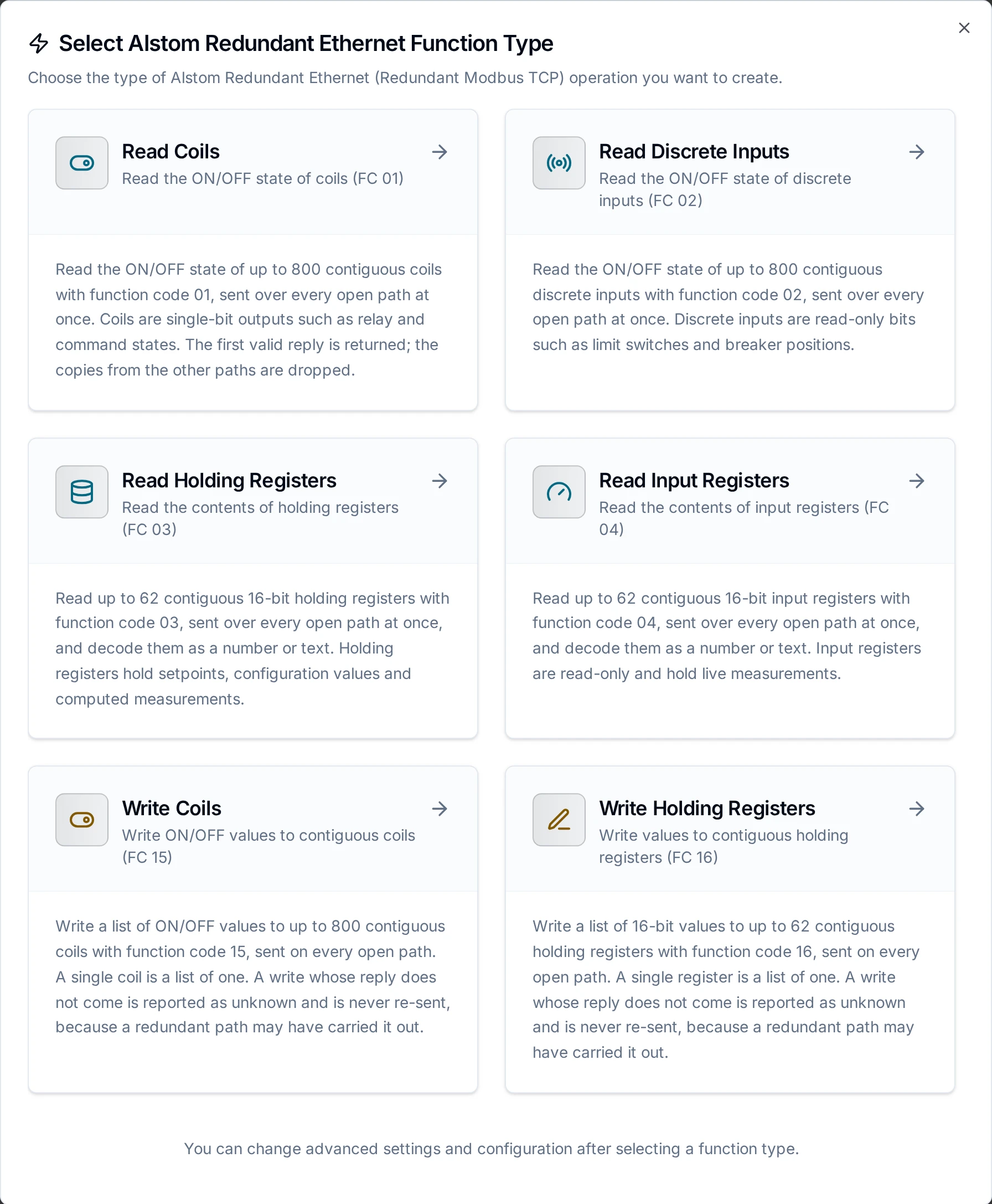
Four reads and two writes
Addresses and the limits of one request
Addresses are the Modbus addresses of the controller's map, as it gives them: MaestroHub does not subtract an offset. The Alstom core sets two limits on every request:
| Limit | Value |
|---|---|
| Last address a request reaches | 9999: address + quantity is at most 10000 |
| Bits in one request (coils, discrete inputs) | 800 |
| Registers in one request (holding, input) | 62 |
A function past a limit is refused when it is saved, and a value filled in by a pipeline is checked before anything is sent.
Read Coils, Read Discrete Inputs (alstomredundant.read.coils, alstomredundant.read.discreteInputs)
Purpose: Read the ON/OFF state of contiguous coils (FC 01) or discrete inputs (FC 02).
| Parameter | Default | Meaning |
|---|---|---|
| Starting Address | (required) | 0 to 9999. Supports ((paramName)) |
| Quantity | 1 | 1 to 800. Supports ((paramName)) |
| Timeout | 30m | Bound on this operation (1s to 1h) |
Read Holding Registers, Read Input Registers (alstomredundant.read.holdingRegisters, alstomredundant.read.inputRegisters)
Purpose: Read contiguous 16-bit registers (FC 03 or FC 04) and decode them.
| Parameter | Default | Meaning |
|---|---|---|
| Starting Address | (required) | 0 to 9999. Supports ((paramName)) |
| Quantity | 1 | 1 to 62. Supports ((paramName)) |
| Data Type | raw | raw (the 16-bit values), bool, int16, uint16, int32, uint32, float32, int64, uint64, float64, string, hex or bits. 32-bit types read 2 registers, 64-bit types 4 |
| Byte Order | ABCD | ABCD (big-endian, the Modbus convention), CDAB (word swap), BADC (bytes swapped in each register) or DCBA (little-endian) |
| Timeout | 30m | Bound on this operation (1s to 1h) |
A wrong byte order gives plausible but wrong numbers: check a known value first.
Write Coils, Write Holding Registers (alstomredundant.write.multipleCoils, alstomredundant.write.multipleRegisters)
Purpose: Write a list of ON/OFF values to contiguous coils (FC 15), or of 16-bit values to contiguous holding registers (FC 16). A single coil or register is a list of one.
| Parameter | Default | Meaning |
|---|---|---|
| Starting Address | (required) | 0 to 9999. Supports ((paramName)) |
| Values | (required) | Coils: a list of true/false, at most 800. Registers: a list of numbers 0 to 65535, at most 62 |
| Timeout | 30m | Bound on this operation (1s to 1h) |
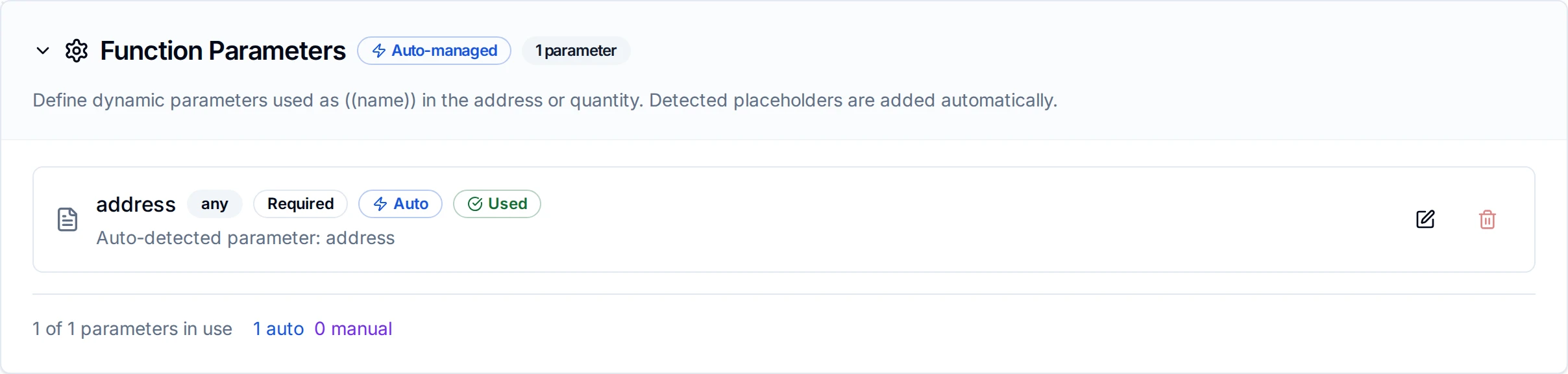
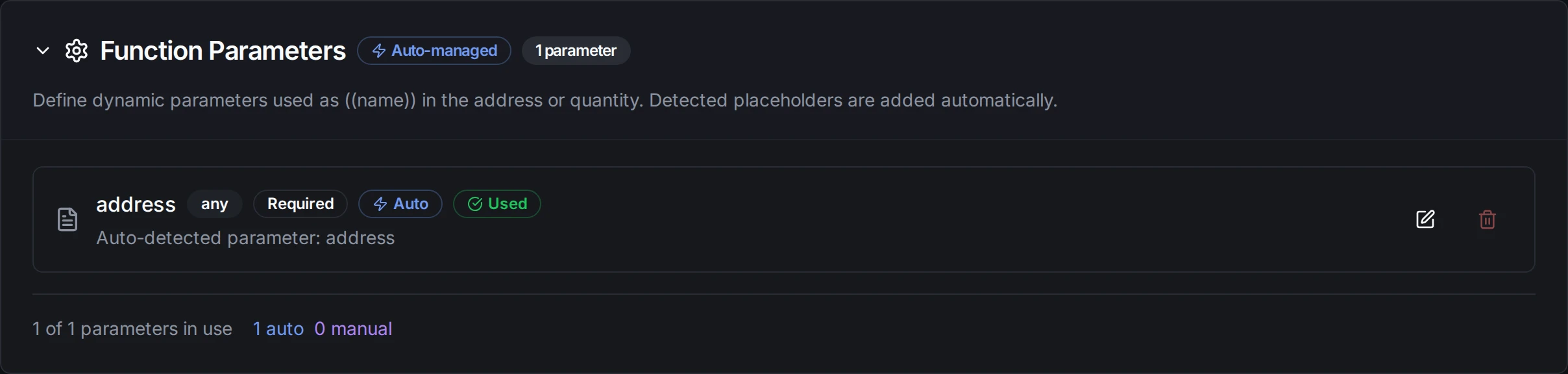
A Read Holding Registers function whose address is the ((address)) parameter, filled by the pipeline
A write goes out on every open path, so each board receives it once per network; the board is expected to drop the second copy by its sequence number, including in the rounds right after a connect or a sequence reset, when the request carries sequence 0. That is the vendor driver's design, not yet confirmed on a real controller (#8737). When no valid reply comes, a board may still have carried it out, so the result says Alstom write failed; delivery may have occurred on a redundant path and is not replayed, and nothing sends it again: not the connector, not the node's Retry on Fail, not a ForEach retry. Check the controller before you send it yourself.
A write is never buffered for later delivery, and a pipeline run started by a late (replayed) input does not execute it unless the node allows late input. When only one path took the write and the controller refused it (Modbus exception 1, 2, 3 or 7), the write did not happen.
Using Parameters
The Starting Address and Quantity fields support ((parameterName)) placeholders; they appear in the Function Parameters block, where you set each one's type, whether it is required, and a default. A filled-in value is checked against the limits when the function runs, and nothing is sent when it does not fit.
Pipeline Integration
Use the functions you configure here as nodes inside the Pipeline Designer. Each function type has its own node:
- Alstom Redundant Ethernet Read Coils (
connected.alstomredundant.read.coils) - Alstom Redundant Ethernet Read Discrete Inputs (
connected.alstomredundant.read.discreteInputs) - Alstom Redundant Ethernet Read Holding Registers (
connected.alstomredundant.read.holdingRegisters) - Alstom Redundant Ethernet Read Input Registers (
connected.alstomredundant.read.inputRegisters) - Alstom Redundant Ethernet Write Coils (
connected.alstomredundant.write.multipleCoils) - Alstom Redundant Ethernet Write Holding Registers (
connected.alstomredundant.write.multipleRegisters)
The controller does not send data on its own: to poll it, drive the reads from a Schedule trigger.
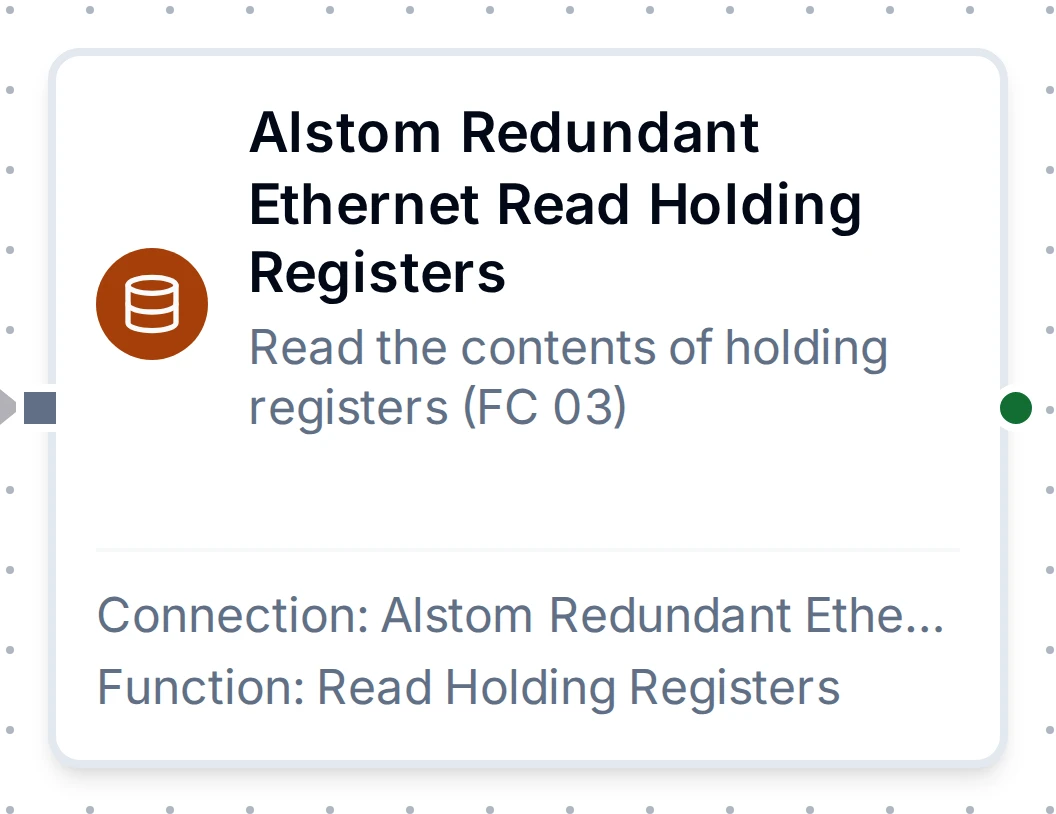
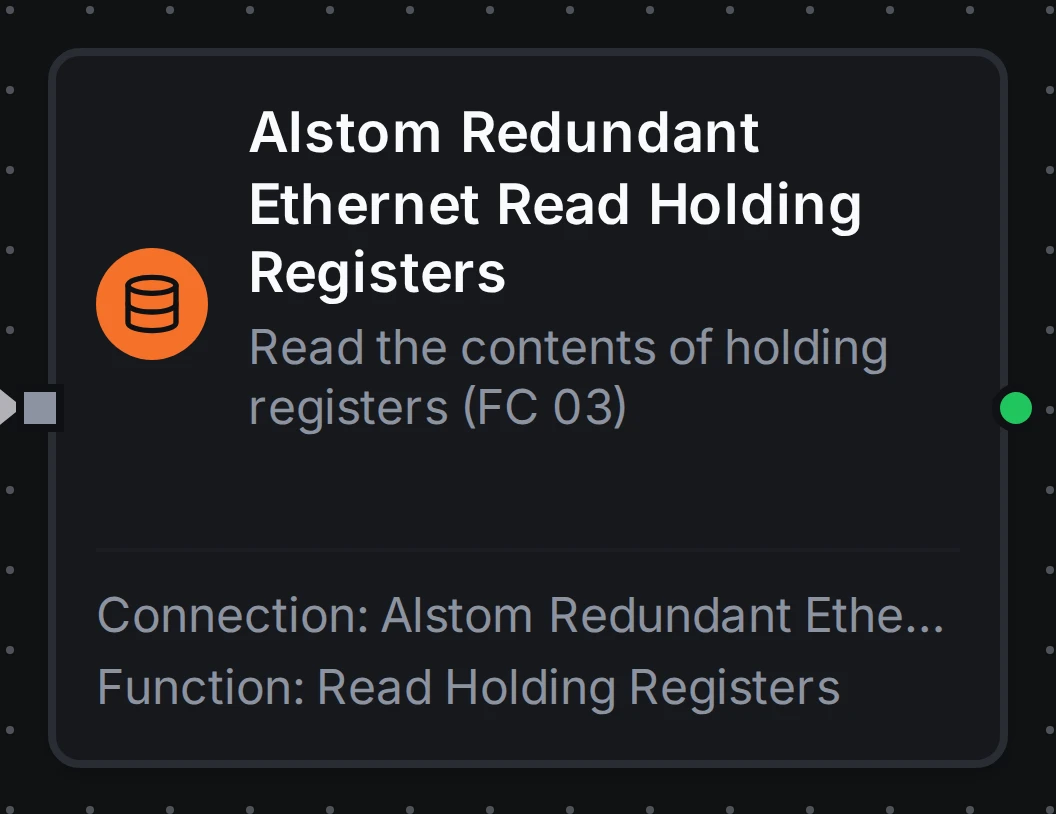
The Read Holding Registers node with its connection and function
For node-level details (output structure, execution settings), see the Alstom Redundant Ethernet Nodes page.
Common Use Cases
Substation and plant values to a historian or the UNS
A Read Holding Registers function per block of measurements (Data Type float32) on a Schedule trigger, routed to a historian or the Unified Namespace. The read keeps working while one network is down.
Breaker and alarm states
Read Discrete Inputs of up to 800 breaker positions and alarm bits in one request, with a Condition node raising a notification on a change.
Setpoints from an operator form
A Write Holding Registers function fed from an operator form, with a Condition node checking the range first. Because a write whose outcome is unknown is never re-sent, show the result to the operator rather than retrying in the pipeline.
Troubleshooting
Error Reference
| What you see | Meaning | Retried? |
|---|---|---|
no Alstom endpoint could be reached | No path opened on connect. Each path and its error is named | Yes, by the connection's reconnect |
Alstom response timeout: no valid Alstom response | A request went out but no valid reply came within the Request Timeout. The (last: …) part names the last reply that was refused, if any | Reads: yes. Writes: never |
Alstom station mismatch | A reply named another station than the Station ID, or another board than the path learned | Reads: yes |
invalid Alstom board sequence | A reply whose sequence number did not move forward. After Invalid Sequences Before Reset of them in a row the group starts over with the board. Keep one MaestroHub connection per controller | Reads: yes |
No Alstom path accepted the request | The request could not be written on any open path | Reads: yes. Writes: never when it may have left |
Alstom write failed; delivery may have occurred on a redundant path and is not replayed | A write's outcome is unknown | Never |
modbus: exception '2' (illegal data address) | The controller refused the request: an address it does not have | No |
… the Alstom core block limit is 62 registers / 800 bits | The request is longer than one request may be. Nothing was sent | No |
… Alstom addresses end at 9999 | The request goes past address 9999. Nothing was sent | No |
not connected to the Alstom controller | Every path is closed | Yes, after reconnect |
"Retried?" says whether the node's Retry on Fail setting sends the request again.
Connection Issues
| Symptom | Possible Cause | Solution |
|---|---|---|
| Connect fails for every path | Wrong addresses or ports, a firewall, or the local interface is not an address of this host | Check each endpoint from the MaestroHub host; clear the local interfaces to let the system choose |
One path keeps dropping (Alstom path dropped warnings in the log) | That network or board is down, or the board stopped reading what is sent to it | The connection keeps working on the other paths; the dropped path is opened again when it answers |
Alstom station mismatch on every read | A wrong Station ID, or endpoints of different controllers in one connection | Check the station ID; put only one controller's endpoints in a connection |
| Numbers that look plausible but wrong | The byte order | Try CDAB for 32-bit values |