Syslog Receive Messages Trigger Node
Start a pipeline for each syslog message a switch, firewall, PLC, HMI or host sends that passes your filter, decoded into severity, facility, host, app, structured data and text.
- Starts on
- Each message that passes the filter
- Function
- Receive Messages
- Transports
- UDP · TCP · TLS
- Dedup
- On change, per hostname
Overview
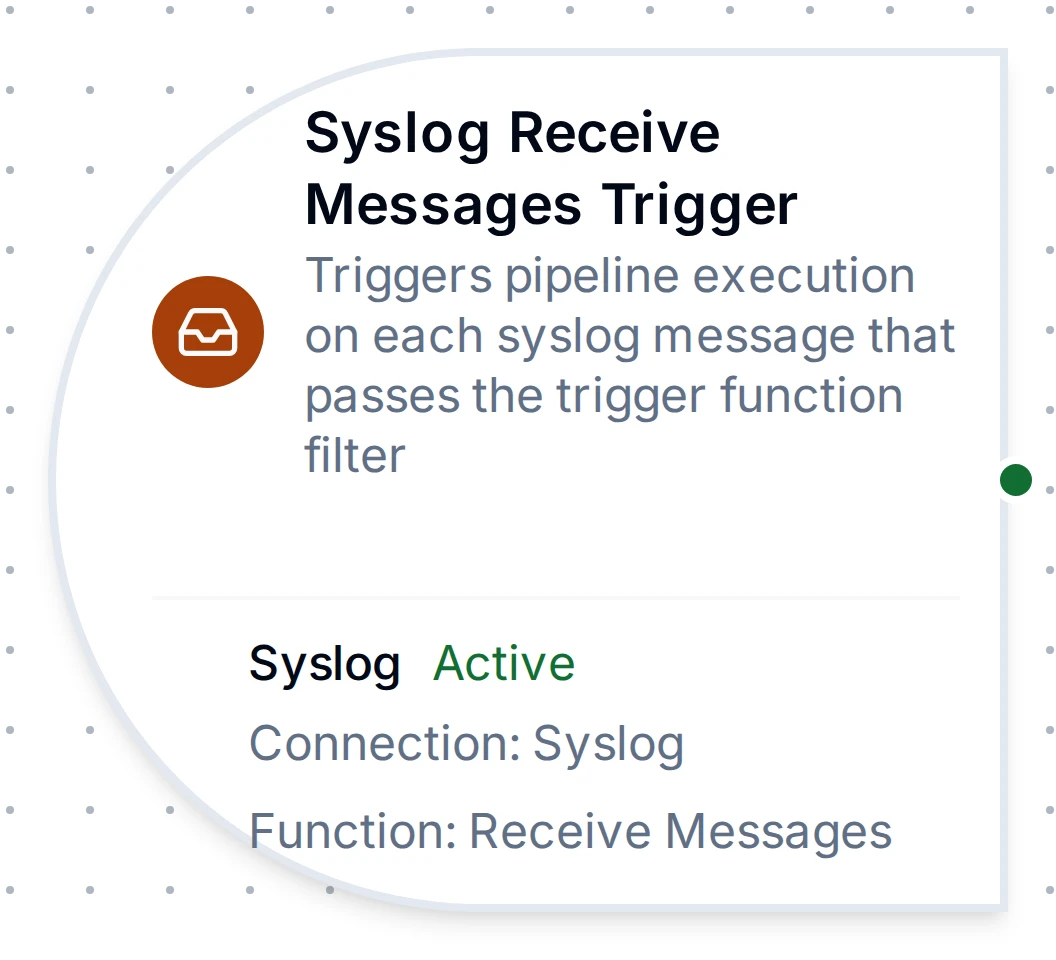
Syslog Receive Messages Trigger node
The Syslog Receive Messages Trigger Node starts a MaestroHub pipeline for every syslog message that a receive-mode Syslog connection gets and that passes the trigger function's filter. Equipment pushes syslog on its own, so this is fully event-driven: nothing is polled.
Core Functionality
What It Does
- Listens: the connection binds its UDP, TCP or TLS port when it starts; the trigger's function is a filter over that one stream of messages.
- Filters before the pipeline: minimum severity, facilities, and host and app name patterns are applied in the connector, so a debug flood from one device never becomes thousands of runs.
- Decodes: RFC 5424 and RFC 3164 are detected per message; header fields, structured data and the device time become
resultand_metadatakeys. - Keeps what does not parse: a message that is neither format is delivered with
format: "unparsed"and the parse error, unless the function drops it.
Unauthenticated until TLS proves otherwise
Anyone who can reach a UDP or TCP syslog port can send a message, and a UDP source address can be spoofed. _metadata.authenticated is "true" only when the connection uses TLS with a CA Certificate and the sender's client certificate was verified; _metadata.tlsPeer then names it. Do not drive device writes or control commands from an unauthenticated trigger. See Receive mode is an open port.
Reconnection Handling
Automatic Recovery
The connection's health check probes its own listener: it sends a probe to the port and waits for the reader to see it. If the socket died, the probe fails and the runtime binds the port again. The trigger function's filter survives the rebind, so events flow again without editing anything.
What This Means for Your Workflows
- Messages sent while the listener is down are lost: syslog over UDP has no retransmission, and TCP senders reconnect on their own timer.
- A restart of MaestroHub binds the port again and resumes the saved pipeline.
Configuration Options
Basic Information
| Field | Description |
|---|---|
| Name | The node name on the canvas |
| Description | Optional notes |
Configuration
| Field | Description |
|---|---|
| Connection | A Syslog connection in receive mode |
| Function | A Receive Messages (syslog.receive) function on it |
| Trigger Mode | always runs on every message; onChange skips a message whose result equals the last one from the same hostname |
Receive Messages Function Configuration
| Parameter | Default | Description |
|---|---|---|
| Minimum Severity | debug | Only messages at least this severe; a message without PRI passes this part |
| Facilities | all | Names or numbers, comma-separated |
| Host Name, App Name | all | Case-insensitive patterns with * and ? |
| Drop Unparsed Messages | off | Drop instead of delivering unparsed messages |
Output Data Structure
Output Format
{
  "result": {
    "message": "Blocked 10.20.0.7 -> 10.4.2.31:502",
    "severity": 3,
    "severityName": "err",
    "facility": 23,
    "facilityName": "local7",
    "hostname": "fw-hall2",
    "appName": "filterlog",
    "procId": "4211",
    "msgId": "BLOCK",
    "structuredData": {"mh@32473": {"zone": "ot", "rule": "12"}},
    "format": "rfc5424"
  },
  "_metadata": {
    "protocol": "syslog",
    "transport": "tcp",
    "peerAddress": "10.4.9.2:51514",
    "format": "rfc5424",
    "hostname": "fw-hall2",
    "appName": "filterlog",
    "severity": "3",
    "facility": "23",
    "sourceTimestamp": "2026-11-03T08:14:07.412Z",
    "serverTimestamp": "2026-11-03T08:14:07.430918Z",
    "authenticated": "false"
  }
}
result Fields
Keys a message did not carry are absent, never filled with a placeholder.
| Field | Description |
|---|---|
message | The message text (MSG), without a byte-order mark; for an unparsed message, the text as received |
format | rfc5424, rfc3164 or unparsed |
severity | 0 (emerg) to 7 (debug). Absent without a PRI |
severityName | emerg, alert, crit, err, warning, notice, info or debug. Absent without a PRI |
facility | 0 to 23. Absent without a PRI |
facilityName | kern … local7. Absent without a PRI |
hostname | HOSTNAME; absent when the message had none or an RFC 5424 - |
appName | APP-NAME, or the RFC 3164 tag; absent when the message had none |
procId | PROCID, or the RFC 3164 tag's [pid]; absent when the message had none |
msgId | MSGID (RFC 5424); absent when the message had none |
structuredData | RFC 5424 structured data: SD-ID to parameter name to value |
timestampCompleted | true when the year and zone of an RFC 3164 time were supplied by MaestroHub |
messageRepaired | true when invalid UTF-8 was replaced with U+FFFD |
raw | The message as received, base64, only when it was repaired |
parseError | Why an unparsed message did not parse |
_metadata Fields
Values are text, as all event metadata is.
| Field | Description |
|---|---|
_metadata.protocol | Always syslog |
_metadata.transport | udp, tcp or tls |
_metadata.peerAddress | The sender's address and port |
_metadata.format | As result.format |
_metadata.hostname | As result.hostname, when present |
_metadata.appName | As result.appName, when present |
_metadata.severity | The severity as a number in text, when present |
_metadata.facility | The facility as a number in text, when present |
_metadata.sourceTimestamp | The device's time in UTC, when the message carried one that parsed |
_metadata.serverTimestamp | When MaestroHub received the message |
_metadata.authenticated | "true" only after a verified client certificate (mutual TLS) |
_metadata.tlsPeer | The verified client certificate's name, under mutual TLS |
Referencing in Downstream Nodes
| Expression | Value |
|---|---|
$trigger.result.message | Blocked 10.20.0.7 -> 10.4.2.31:502 |
$trigger.result.severity | 3 |
$trigger.result.structuredData["mh@32473"].zone | ot |
$trigger._metadata.hostname | fw-hall2 |
$trigger._metadata.authenticated | false |
For the connection, see the Syslog connection guide. To send syslog from a pipeline, see the Syslog nodes.