Syslog Nodes
Send a pipeline event to a syslog collector or SIEM, as an RFC 5424 or RFC 3164 message, over UDP, TCP or TLS.
- Needs
- A Syslog connection in send mode
- Operations
- Syslog Send Message
- Formats
- RFC 5424 · RFC 3164
- Delivery
- Accepted by the socket, never acknowledged
Send events from pipelines to the plant's syslog collector or SIEM. Each Send Message function authored on a send-mode Syslog connection is available as a node in the Pipeline Designer.
For connection setup, ports, TLS and the egress guard, see the Syslog connection guide.
For the event-driven trigger, see the Syslog Receive Messages Trigger. It starts a pipeline for each received message that passes a filter (trigger.syslog); its result is the decoded message, read as $trigger.result.message, $trigger.result.severity and so on.
Configuration Quick Reference
| Field | What you choose | Details |
|---|---|---|
| Parameters | Connection, Function, Function Parameters, Timeout Override | Select the send-mode Syslog connection, pick a function, bind parameters with expression support, and optionally override the timeout. |
| Settings | Description, Timeout (seconds), Retry on Timeout, Retry on Fail, On Error | Node description, maximum execution time, retry behaviour and error strategy. All execution settings default to pipeline-level values. |
Syslog Send Message Node
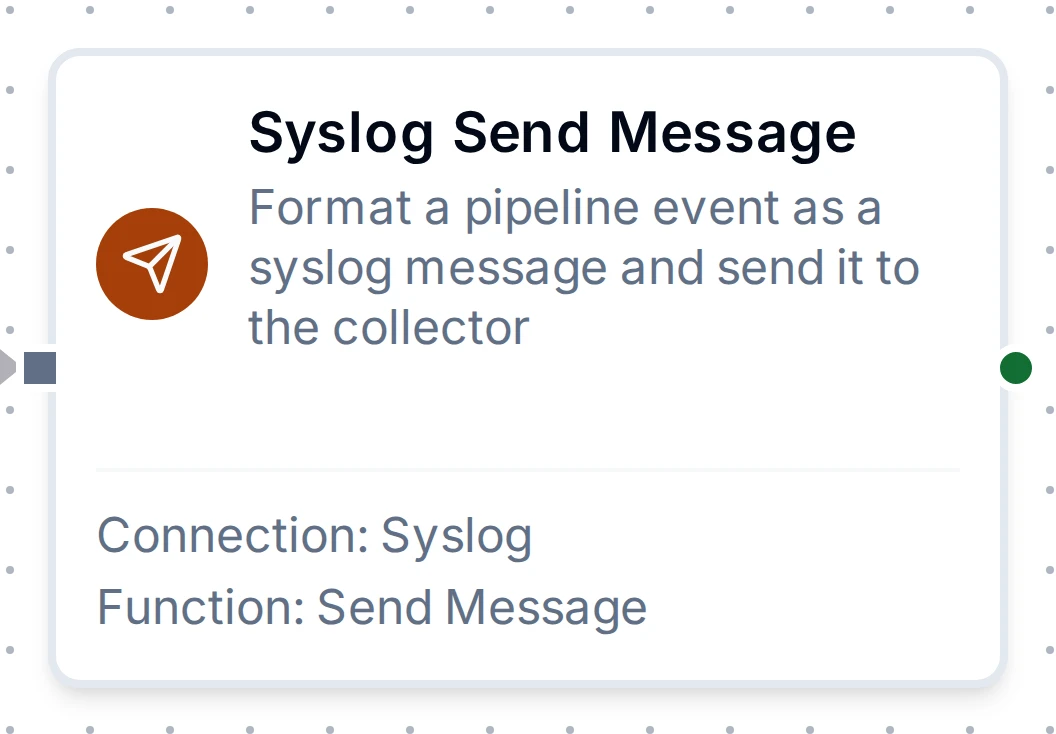
Syslog Send Message node
Supported Function Types:
| Node | Function | Purpose | Common Use Cases |
|---|---|---|---|
Syslog Send Message (connected.syslog.send) | syslog.send | Format one message and send it to the collector | Forward machine alarms to the SIEM, log recipe changes centrally |
Node Configuration
| Parameter | Type | Required | Description |
|---|---|---|---|
| Message | string | Yes | The message text (MSG). Templatable. |
| Severity | integer 0 to 7 | No | Default 6 (info). Templatable. |
| Facility | integer 0 to 23 | No | Default 1 (user). Templatable. |
| Host Name, App Name, Process ID, Message ID | string | No | The RFC 5424 header fields; printable ASCII, no spaces. |
| Structured Data | JSON text | No | RFC 5424 only: {"line@32473": {"id": "3"}}. |
| Timestamp | RFC 3339 | No | Empty uses the time of sending. |
Every value is checked before anything is sent: a bad one fails the node with nothing written. A message longer than the connection's Max Message Bytes is refused, never cut.
Output Structure
{
  "result": {
    "accepted": true,
    "bytesWritten": 112,
    "format": "rfc5424",
    "framing": "octet-counting"
  }
}
| Key | Meaning |
|---|---|
result.accepted | The socket accepted the message's bytes. Syslog has no acknowledgement, so this is not proof the collector stored it |
result.bytesWritten | How many bytes went to the socket, framing included |
result.format | rfc5424 or rfc3164, as the connection's Message Format says |
result.framing | octet-counting over TCP and TLS (RFC 6587, RFC 5425); none over UDP, one message per datagram |
Delivery and Retries
- A write that failed after leaving may have reached the collector; it is Transient, and the platform may send it again, accepting a possible duplicate line.
- Store & Forward buffers Send Message through a collector outage: a log line repeated is a duplicate line, not a second machine action.
- Nothing is retried inside the connector; the node's Retry on Fail decides.