ControlLogix Server Receive Tag Writes Trigger Node
Start a pipeline for each write an HMI or PLC makes to a writable tag of MaestroHub's emulated ControlLogix.
- Starts on
- Each outside write that lands
- Function
- Receive Tag Writes
- Needs
- Allow Outside Writes on, tags marked writable
- Dedup
- On change, per tag
Overview
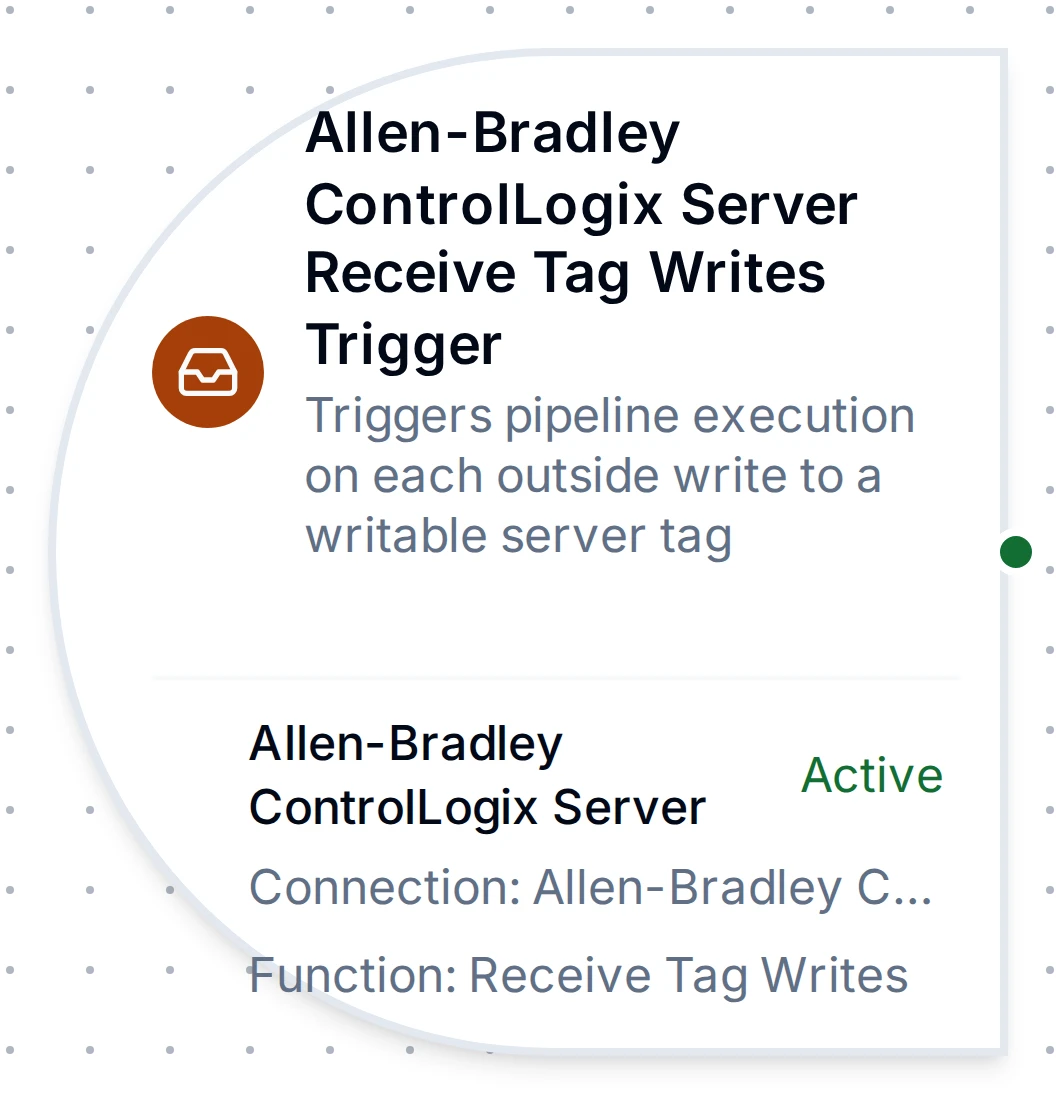
Receive Tag Writes Trigger node
The Receive Tag Writes Trigger Node starts a MaestroHub pipeline for every write an outside client (an HMI, a SCADA client, a PLC's MSG instruction) makes to a writable tag of an Allen-Bradley ControlLogix Server connection. Clients push writes on their own, so nothing is polled.
Core Functionality
What It Does
- Fires on writes that land: a Write Tag, the last fragment of a Write Tag Fragmented (one event for the whole value), or a Read Modify Write. The client has its answer already; the event follows.
- Never on a refused write: a write to a tag not marked writable, of the wrong data type, beyond the array, or while outside writes are off, is answered with its CIP status and starts nothing.
- Never on a pipeline's own Set Server Tag: only outside writes.
- Filters by tag: a function lists the tags it listens to, or listens to every writable tag.
Unauthenticated
CIP has no authentication: a write proves only that something on an allowed address sent it. Check what a write asks for in the pipeline before it drives equipment. See CIP has no authentication.
Reconnection Handling
The connection's health check registers an EtherNet/IP session on its own listener. If the listener died, the check fails and the runtime binds the port again; the trigger's function stays installed and fires again without editing anything. Clients reconnect on their own timer, and a write a client sent while the server was down was refused at the client.
Configuration Options
| Field | Description |
|---|---|
| Connection | An Allen-Bradley ControlLogix Server connection |
| Function | A Receive Tag Writes (logixserver.writes) function on it |
| Trigger Mode | always runs on every write; onChange skips a write whose result equals the last one to the same tag |
Receive Tag Writes Function Configuration
| Parameter | Default | Description |
|---|---|---|
| Tags | every writable tag | Only writes to these tags, separated by commas. Each must be declared and writable. |
Output Data Structure
{
  "result": {
    "tag": "Setpoint",
    "dataType": "REAL",
    "index": 0,
    "count": 1,
    "value": 72.5
  },
  "_metadata": {
    "protocol": "logixserver",
    "tag": "Setpoint",
    "service": "write",
    "peerAddress": "10.20.3.4:51544",
    "serverTimestamp": "2026-11-20T09:14:07.120918Z"
  }
}
result Fields
| Field | Description |
|---|---|
tag | The tag written, as declared on the connection |
dataType | The tag's data type |
index | The first element written |
count | How many elements were written |
value | The new value: one value, or a list for several elements |
_metadata Fields
| Field | Description |
|---|---|
protocol | logixserver |
tag | The tag written |
service | write (Write Tag), writeFragmented (Write Tag Fragmented) or readModifyWrite |
peerAddress | The writer's address and port |
serverTimestamp | When MaestroHub committed the write |
Access them in later nodes as $trigger.result.value and $trigger._metadata.peerAddress.
Overload
A client's write is answered at once and cannot be held back. When the pipeline cannot keep up, the waiting events are dropped and counted (overload drop); the writes themselves have landed in the tag.
One client can start many runs. There is no limit per client: every write that lands starts a run, so a client that writes in a loop starts runs as fast as it writes, and what the pipeline cannot take is dropped and counted as above, for every client of the connection alike. Keep Allowed Sources to the clients that must write, and mark only the tags they write as writable.