Qdrant Nodes
Store the embeddings of manuals, SOPs and events, and find the nearest ones when the plant needs them.
- Needs
- A Qdrant connection
- Operations
- Upsert Points, Search, Get Points, Delete Points
- Output
- Point ids, or the points found
Qdrant is a vector database. MaestroHub's Qdrant nodes store points (an id, a vector and a JSON payload), search the points nearest to a query vector, read points by id and delete them.
Configuration Quick Reference
| Field | What you choose | Details |
|---|---|---|
| Parameters | Connection, Function, Function Parameters, Timeout Override | Select the connection profile, function, configure function parameters with expression support, and optionally override timeout. |
| Settings | Description, Timeout (seconds), Retry on Timeout, Retry on Fail, On Error | Node description, maximum execution time, retry behavior on timeout or failure, and error handling strategy. All execution settings default to pipeline-level values. |
Every node delivers its data under result, and execution facts (success, functionId, durationMs, timestamp) under _metadata, with the call's own facts in $node["Name"]._metadata.method (the operation), $node["Name"]._metadata.connectionId (the connection it ran over), $node["Name"]._metadata.protocol (qdrant) and $node["Name"]._metadata.collection (the collection).
A text id such as SOP-114#3 is stored under a UUID made from the text, the same on every node, so results show that UUID. See Point IDs.
Qdrant Upsert Points Node
Qdrant Upsert Points Node
Stores up to 1,000 points in a collection. A point whose id is already there is replaced. The node succeeds once Qdrant has applied every point; when Qdrant refuses one, none is written.
Output
| Expression | Description |
|---|---|
$node["Name"].result.ids | The id of each point written, in the order given: a whole number or a UUID, as Qdrant keeps it |
$node["Name"].result.pointCount | How many points were written |
Qdrant Search Node
Qdrant Search Node
Returns the Top K points nearest to a query vector, closest first, optionally only points whose payload matches a Qdrant filter.
Output
| Expression | Description |
|---|---|
$node["Name"].result.points | The nearest points, closest first, as Qdrant returns them: id, version, score, payload (with Include Payload) and vector (with Include Vectors). Higher score is closer for Cosine and Dot collections, lower for Euclid and Manhattan |
$node["Name"].result.pointCount | How many points came back; fewer than Top K when fewer match |
The first match's text, for example: $node["Name"].result.points[0].payload.text.
Qdrant Get Points Node
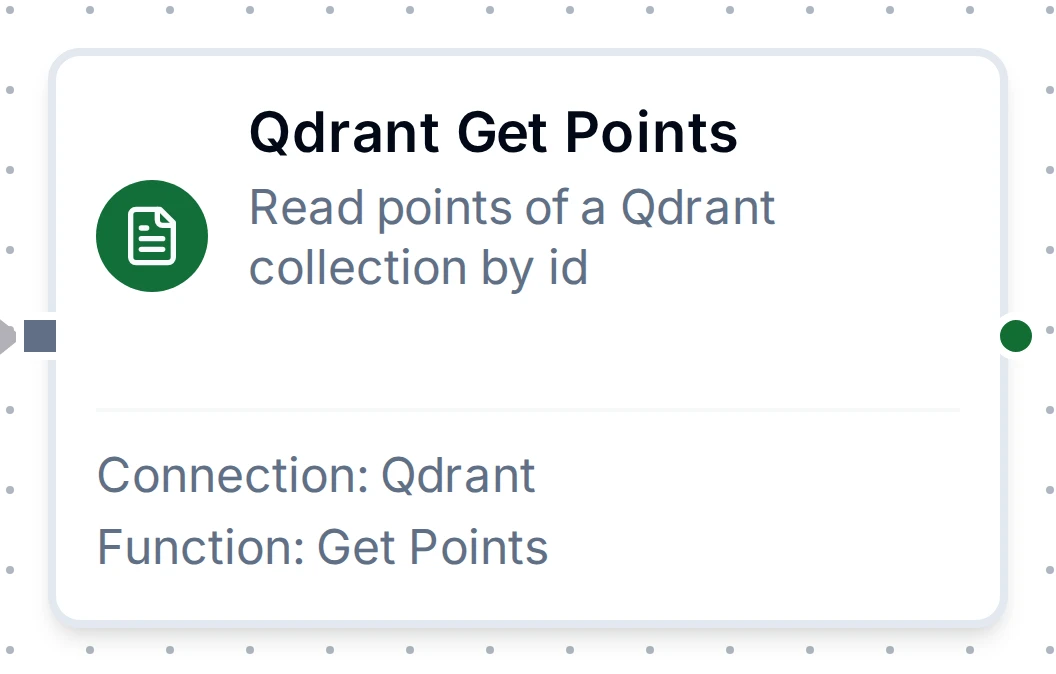
Qdrant Get Points Node
Reads up to 1,000 points by id.
Output
| Expression | Description |
|---|---|
$node["Name"].result.points | The points found, as Qdrant returns them: id, payload (with Include Payload) and vector (with Include Vectors) |
$node["Name"].result.pointCount | How many points were found |
$node["Name"].result.missingIds | The ids asked for that the collection does not hold. Absent when every id was found |
Qdrant Delete Points Node
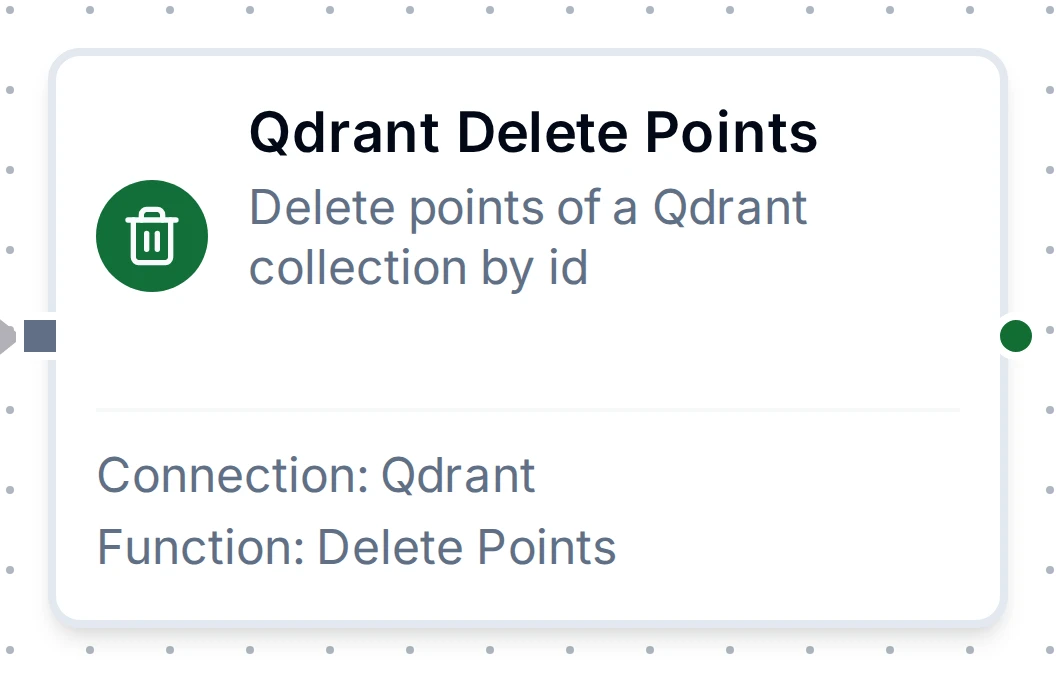
Qdrant Delete Points Node
Deletes up to 1,000 points by id. An id the collection does not hold is not an error, so a repeated delete is harmless.
Output
| Expression | Description |
|---|---|
$node["Name"].result.ids | The ids the delete named, including any the collection did not hold: Qdrant does not say which existed |
$node["Name"].result.pointCount | How many ids the delete named |
For every function field, see the Qdrant Integration Guide.