gRPC Nodes
Call a method of any gRPC service from a pipeline, with the request as JSON from upstream nodes.
- Needs
- A gRPC connection
- Operations
- grpc.query · grpc.invoke
- Output
- result.response · result.responses · result.status
Each gRPC operation is its own node, under APIs in the node palette. A node runs a saved function of its operation on a gRPC connection. To start a pipeline from a stream instead, use the gRPC trigger.
Configuration Quick Reference
| Field | What you choose | Details |
|---|---|---|
| Parameters | Connection, Function, Function Parameters, Timeout Override | Select the connection, the function, fill the ((parameters)) of its request from upstream data, and optionally override the timeout. |
| Settings | Description, Timeout, Retry on Timeout, Retry on Fail, On Error | Node description, maximum execution time, retry behaviour and error handling. All default to the pipeline's values. |
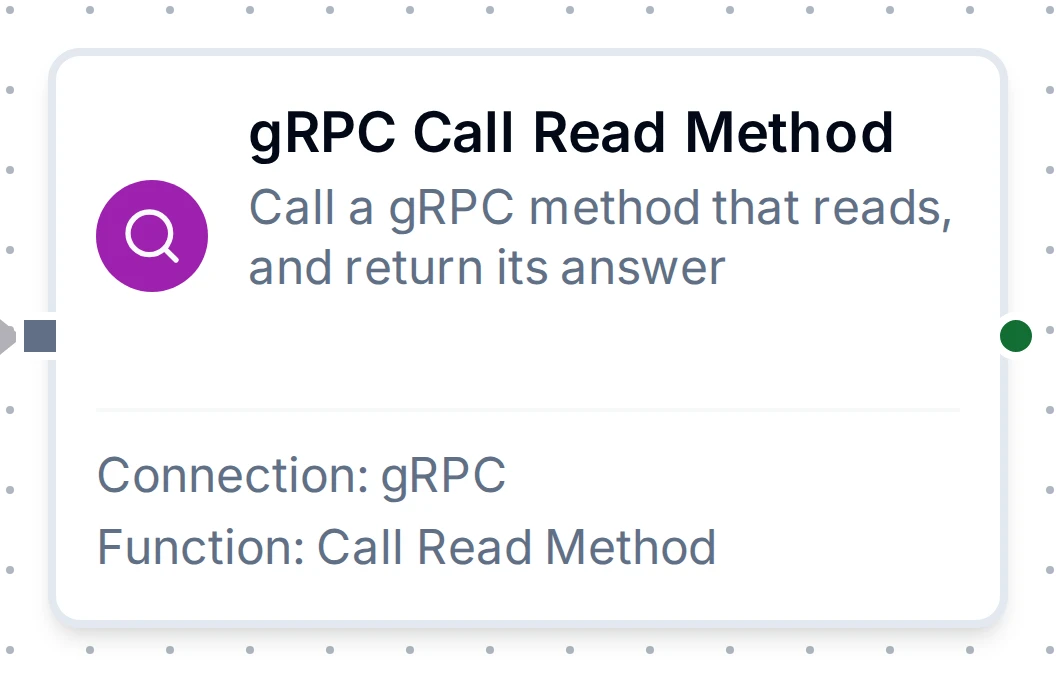
gRPC Call Read Method Node
gRPC Call Read Method Node
Calls a method that only reads, with the function's request. A method with one answer returns it in result.response. A method that answers with a stream is read until the server ends it or Max Responses is reached; every message is in result.responses, and result.complete says whether the server ended the stream.
Output
{
  "result": {
    "response": { "lineId": "L3", "state": "RUNNING", "producedCount": "18250" },
    "responses": [],
    "complete": true,
    "headers": { "content-type": "application/grpc" },
    "trailers": {},
    "status": { "code": "OK", "message": "", "details": [] }
  }
}
| Expression | Description |
|---|---|
$node["Name"].result.response | The answer message as JSON, e.g. $node["Name"].result.response.state. For a method that answers with a stream it is the last message received, or null when there was none. 64-bit integers are text, enums their names, timestamps RFC 3339 text |
$node["Name"].result.responses | Every message of a method that answers with a stream, in the order received; empty for a method with one answer |
$node["Name"].result.complete | false when a bound (Max Responses, or 64 MiB of answers) kept the result from holding every message of a streaming answer |
$node["Name"].result.headers | The metadata the server sent before its answer, one text per key (several values joined with a comma) |
$node["Name"].result.trailers | The metadata the server sent after its answer |
$node["Name"].result.status | The gRPC status the call ended with: code, message and details. OK, or CANCELLED when a read was stopped at a bound. A call the server ends with any other code fails the node |
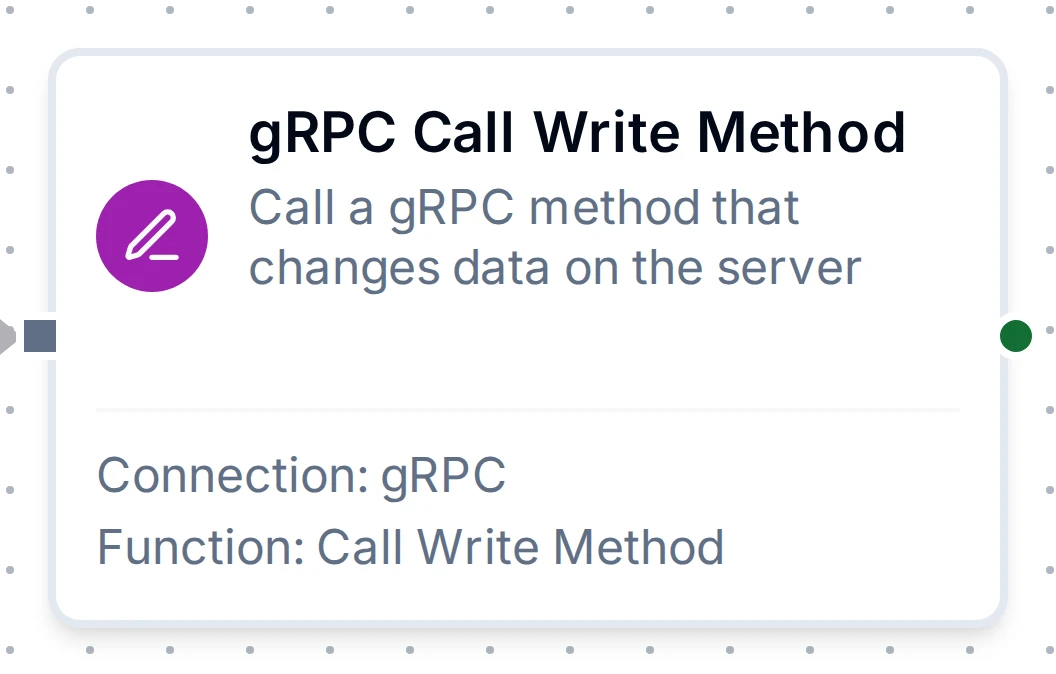
gRPC Call Write Method Node
gRPC Call Write Method Node
Calls a method that changes data. gRPC does not say whether a method is safe to repeat, so the connector sends a write once. A write whose answer was lost (a timeout, a dropped connection) may already have run on the server, and is never sent again automatically. With store-and-forward on, a buffered write is sent when the link returns, and carries its write key as the idempotency-key metadata entry.
A method that takes a stream of requests takes a JSON list of messages and sends them on one call. A write is never cut at Max Responses: every request message is sent, and answers past the bound are read and dropped.
Output: the same keys as the Call Read Method node: result.response, result.responses, result.complete, result.headers, result.trailers and result.status.
Metadata
Every node also carries _metadata: the shared execution facts (success, functionId, durationMs, timestamp) and the call's own: _metadata.method (the operation), _metadata.connectionId, _metadata.protocol (grpc), _metadata.grpcMethod (the method called, as package.Service/Method), _metadata.kind (unary, serverStreaming, clientStreaming or bidiStreaming), and _metadata.warning when a read was stopped before the server ended the stream.
Failures
A node fails with the status code and the server's message when the call ends with anything other than OK. INVALID_ARGUMENT, NOT_FOUND, ALREADY_EXISTS, FAILED_PRECONDITION, OUT_OF_RANGE, PERMISSION_DENIED, UNAUTHENTICATED and UNIMPLEMENTED are refusals the same request would meet again, so Retry on Fail does not help. RESOURCE_EXHAUSTED, UNAVAILABLE, ABORTED, INTERNAL, a deadline and network failures are temporary. A stream cut short by an error fails the node: the messages read so far are not returned as the answer.
A method the contract does not have, a request field its message does not define, a list where one message belongs, or metadata that is not a JSON object fail the node before anything is sent.