gRPC Integration Guide
Call the methods of your own services, MES and cloud APIs that speak gRPC, and start pipelines from their streams, with requests and answers as JSON.
- Authentication
- None · Basic · Bearer · API key · OAuth2 token · mutual TLS
- Operations
- Call Read Method · Call Write Method · Subscribe
- Transport
- gRPC over HTTP/2, plain or TLS
Overview
The gRPC connector is a client: MaestroHub connects to a gRPC server and calls its methods, as the REST connector calls an HTTP API. It works with any service, without generated code.
- Call Read Method: call a method that only reads, such as a line's status.
- Call Write Method: call a method that changes data, such as reporting a quantity or sending a command.
- Subscribe: keep a server-streaming method open and start a pipeline for every message it sends.
All four kinds of gRPC method are supported: unary, server streaming, client streaming and bidirectional streaming.
Why two call functions? gRPC does not say whether a method changes data. You say it by choosing the function, and permissions, retries and store-and-forward follow that choice: a failed read is retried as the node's settings ask, and a write whose outcome is unknown is never sent again automatically.
Prerequisites
- The server's host and port, reachable from MaestroHub.
- The service's contract, one of:
- server reflection switched on at the server, so MaestroHub can ask it for its definitions;
- its .proto files;
- a compiled descriptor set.
- Credentials, and the CA certificate if the server's certificate comes from your own CA.
Connection Configuration
Navigate to Connections → New Connection → gRPC.
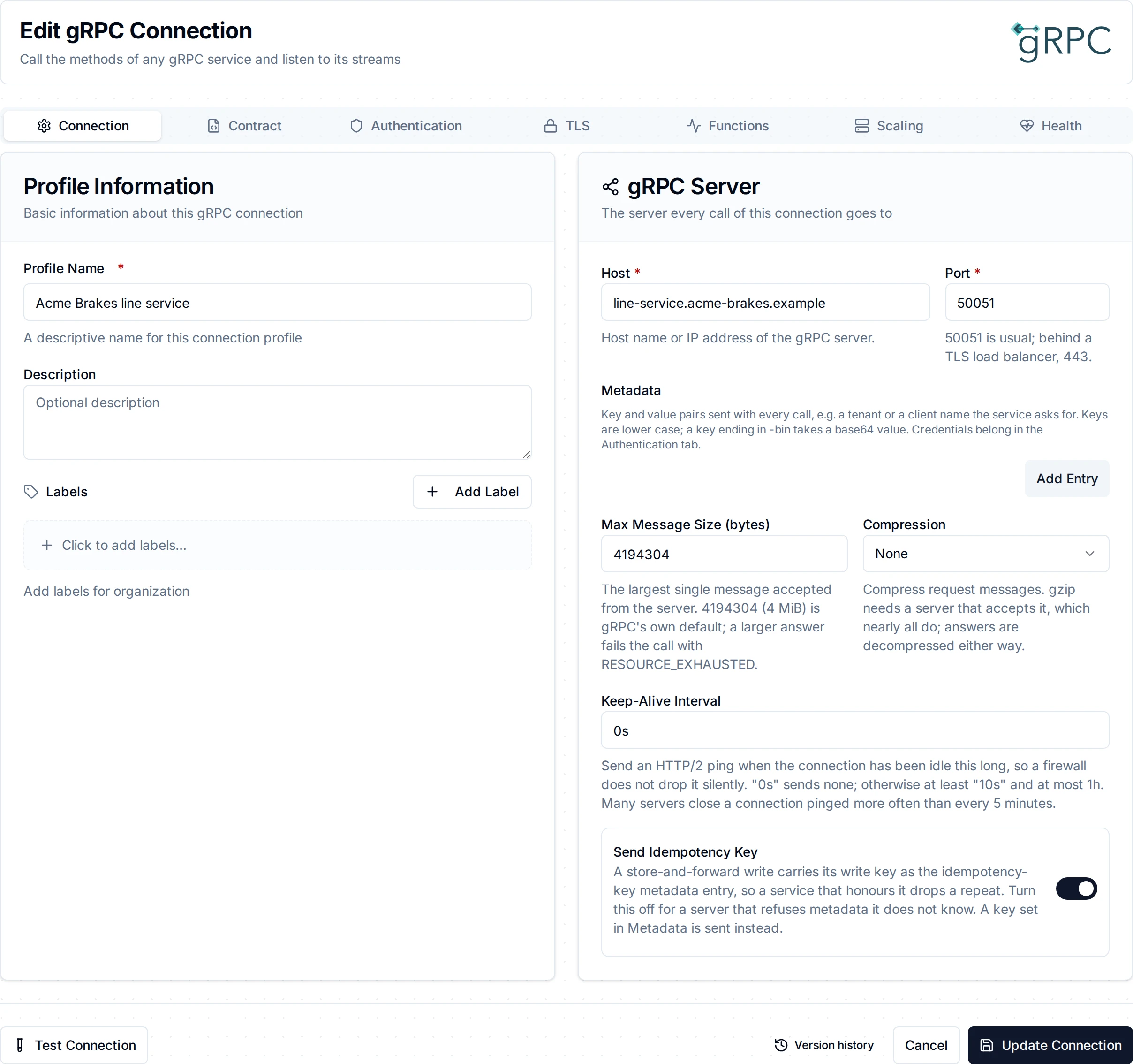
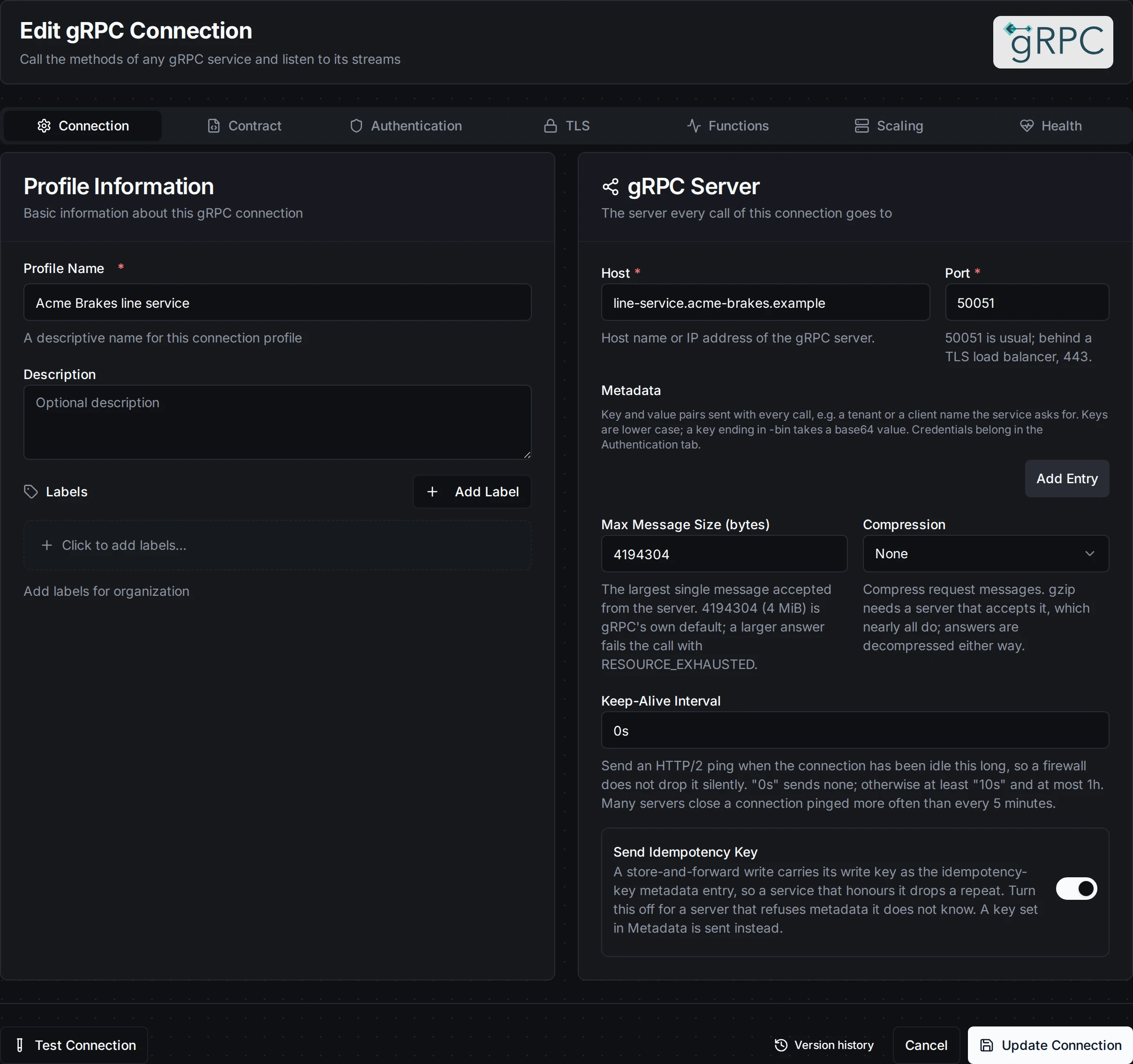
The Connection tab: the server, metadata and message settings
Connection
| Field | Default | Description |
|---|---|---|
| Profile Name | - | A descriptive name for this connection (required, at most 100 characters) |
| Description | - | Optional |
| Host | - | Host name or IP address of the gRPC server (required) |
| Port | 50051 | The server's port. One behind a TLS load balancer is usually on 443 |
| Metadata | - | Key and value pairs sent with every call, e.g. a tenant the service asks for. Keys are lower case; a key ending in -bin takes a base64 value |
| Max Message Size (bytes) | 4194304 | The largest single message accepted from the server (4 MiB, gRPC's own default) |
| Compression | none | gzip compresses request messages |
| Keep-Alive Interval | 0s | Send an HTTP/2 ping when the connection has been idle this long, so a firewall does not drop it silently. 0s sends none; otherwise at least 10s |
| Send Idempotency Key | On | A store-and-forward write carries its write key as the idempotency-key metadata entry. Turn it off for a server that refuses metadata it does not know |
Contract
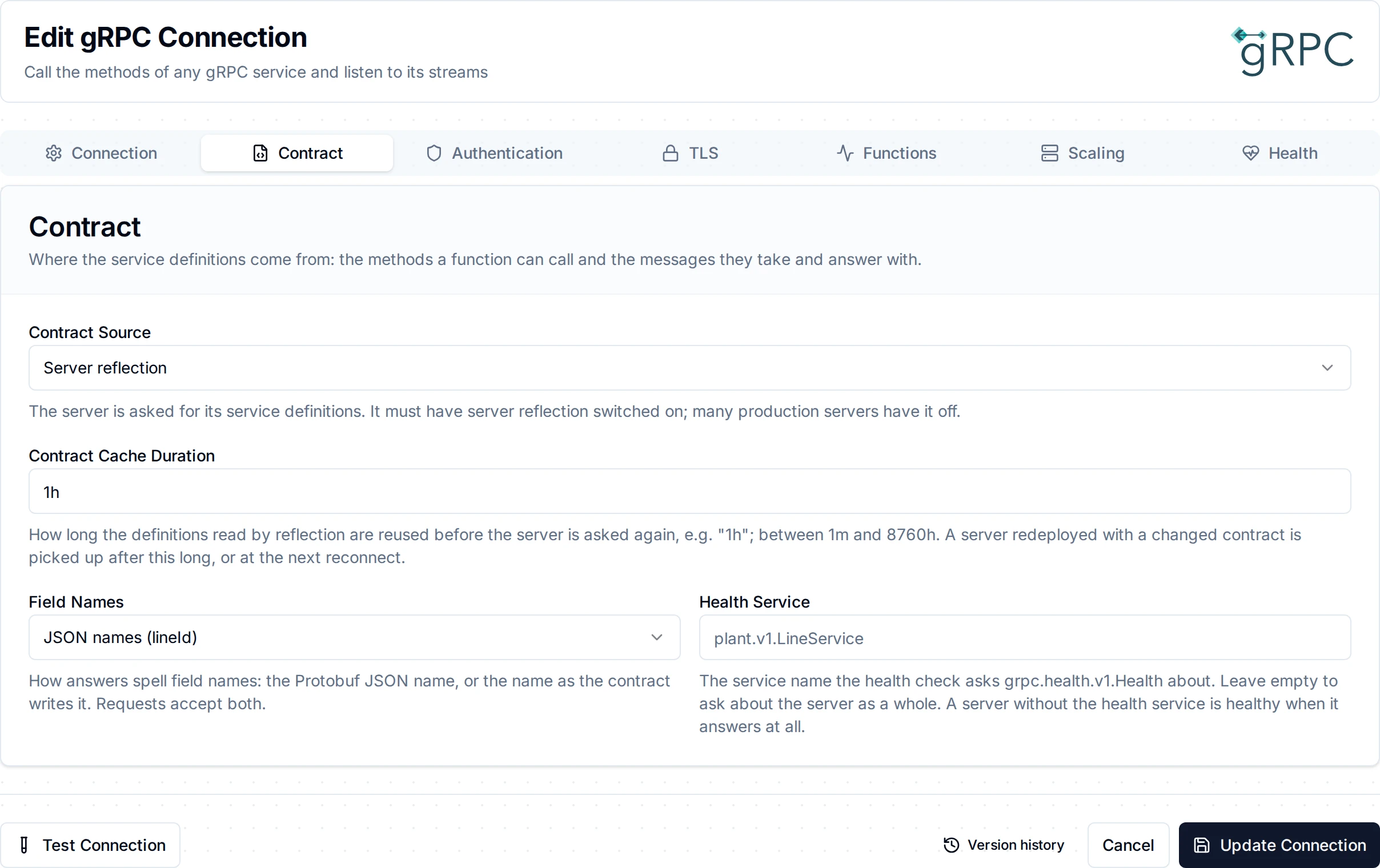
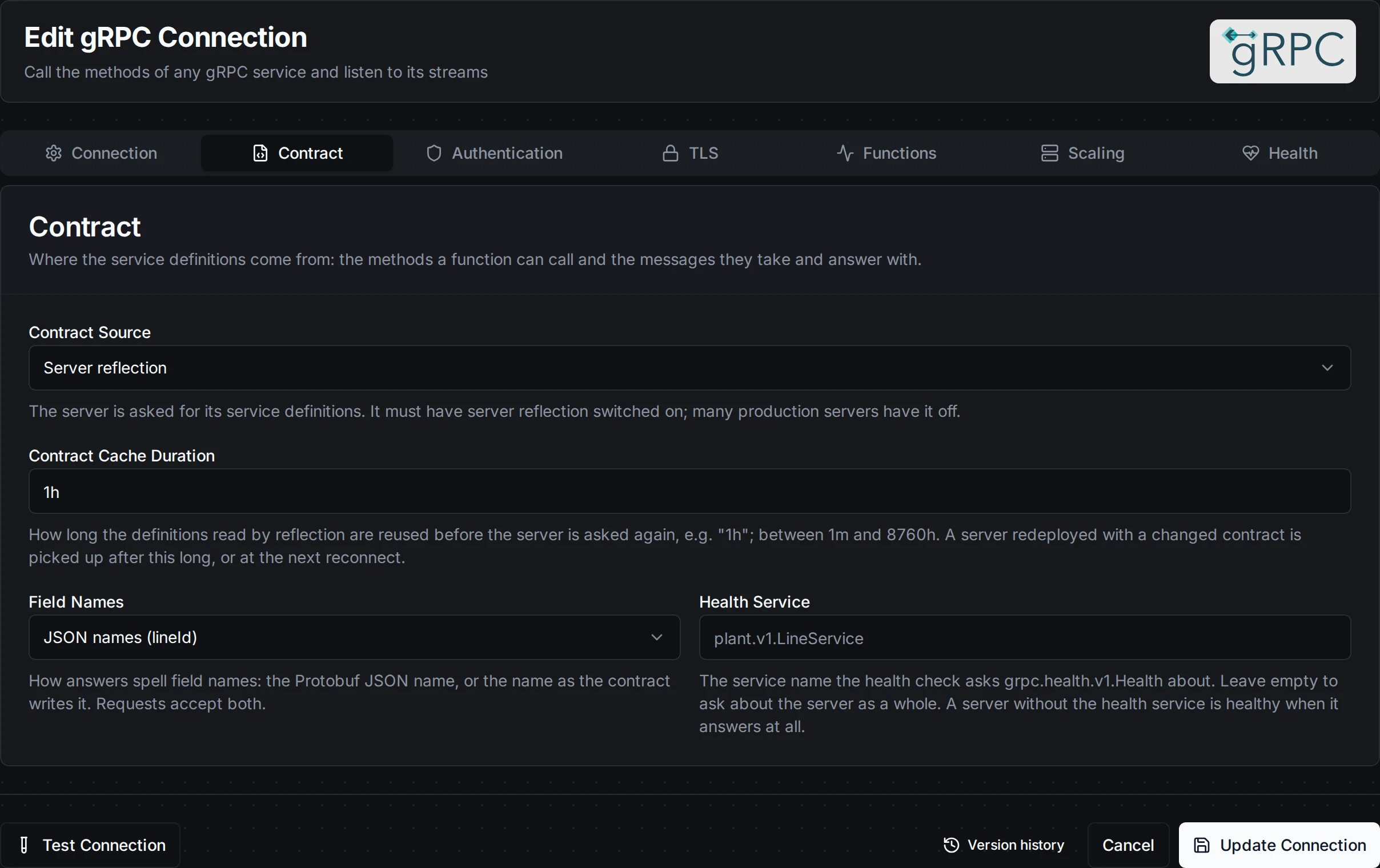
The Contract tab: where the service definitions come from
| Field | Default | Description |
|---|---|---|
| Contract Source | reflection | reflection asks the server for its definitions; files compiles the .proto files you upload; descriptor reads a compiled descriptor set |
| .proto Files | - | With files: the service's .proto files. Files that import each other are matched by path, or by file name when uploaded without their folders. google/protobuf imports need no upload |
| Descriptor Set | - | With descriptor: the file written by protoc --include_imports --descriptor_set_out=contract.binpb or buf build -o contract.binpb |
| Contract Cache Duration | 1h | With reflection: how long the definitions are reused before the server is asked again |
| Field Names | json | How answers spell field names: json is the Protobuf JSON name (lineId), proto the name as the contract writes it (line_id). Requests accept both |
| Health Service | - | The service name the health check asks about. Leave empty to ask about the server as a whole |
Uploaded files are compiled when you save. A file that does not compile is refused with its name and line.
Many production servers have reflection switched off. Connecting to one with reflection fails with a message saying so: switch Contract Source to files and upload its .proto files.
Authentication
Credentials are sent as gRPC metadata with every call.
| Type | Fields | What is sent |
|---|---|---|
| None | - | Nothing |
| Basic | Username, Password | authorization: Basic ... |
| Bearer | Bearer Token | authorization: Bearer <token> |
| API key | API Key Header, API Key | The key under the metadata key you name, e.g. x-api-key |
| OAuth2 token | Token URL, Token Request Body and its options | A token fetched from the token endpoint, reused for the Token Cache Duration, and fetched again when the server refuses it |
Credentials sent without TLS travel in clear text.
TLS
| Field | Default | Description |
|---|---|---|
| Use TLS | Off | Encrypt the connection. Off sends plain HTTP/2, for a server inside a trusted network |
| CA Certificate (PEM) | - | A CA that signed the server's certificate. Leave empty to trust the system's CAs |
| Client Certificate (PEM), Client Private Key (PEM) | - | For mutual TLS |
| Server Name | - | The name the server's certificate is checked against, when it differs from Host |
| Skip Certificate Verification | Off | Accept any server certificate. Insecure: for tests only |
Health check
MaestroHub asks the standard gRPC health service (grpc.health.v1.Health). A server that answers SERVING is healthy; one that answers NOT_SERVING is not. A server without the health service is healthy when it answers at all.
Function Builder
After saving the connection, open its Functions tab → New Function and choose Call Read Method, Call Write Method or Subscribe.
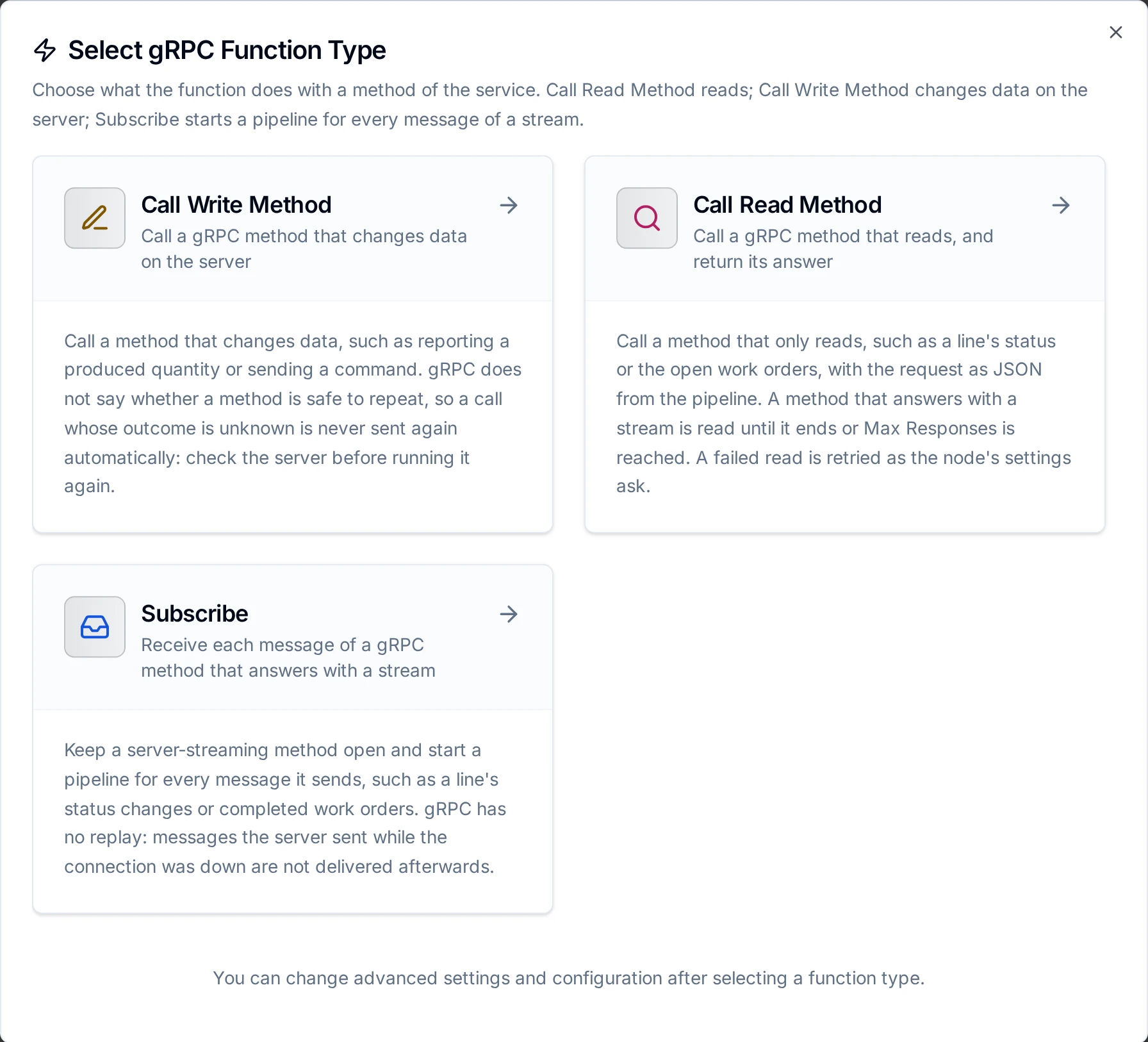
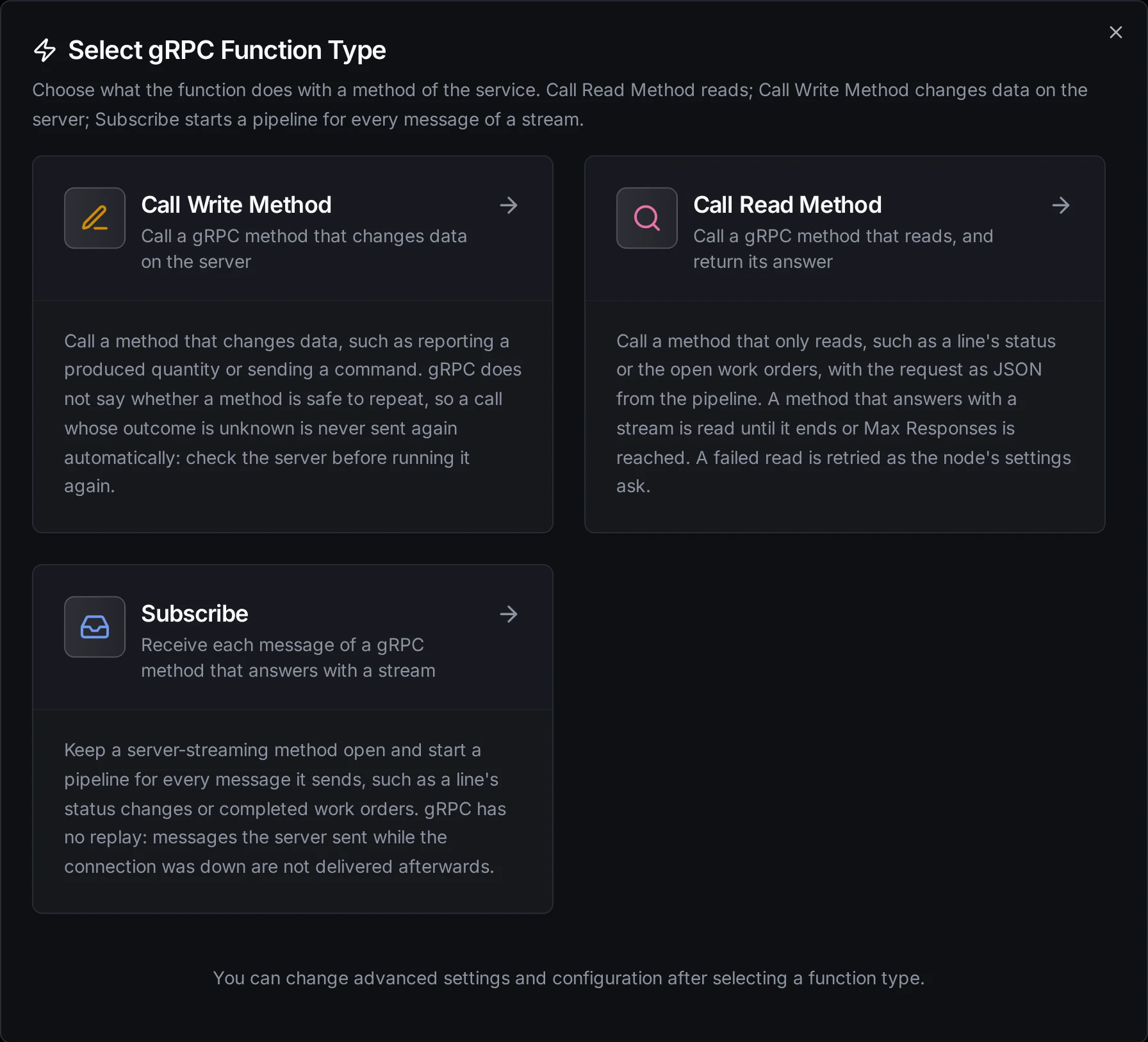
Call Read Method reads, Call Write Method writes, Subscribe feeds a trigger
Call Read Method and Call Write Method
| Field | Required | Description |
|---|---|---|
| Method | Yes | The method to call, as package.Service/Method, picked from the connection's contract. Called as written: it cannot hold ((parameters)) |
| Request | Call Write Method | The request message as JSON, e.g. {"lineId": "((lineId))"}. Supports ((parameters)). A method that takes a stream takes a JSON list of messages, at most 10000 |
| Metadata | No | A JSON object of metadata sent with this call, beside the connection's |
| Max Responses | No | The most messages collected from a method that answers with a stream, 1000 by default and at most 10000. The call is cancelled at that number |
| Timeout | No | Bound on this operation, 30s by default |
Picking a method fills Request with a template of its message: every field with a placeholder value.
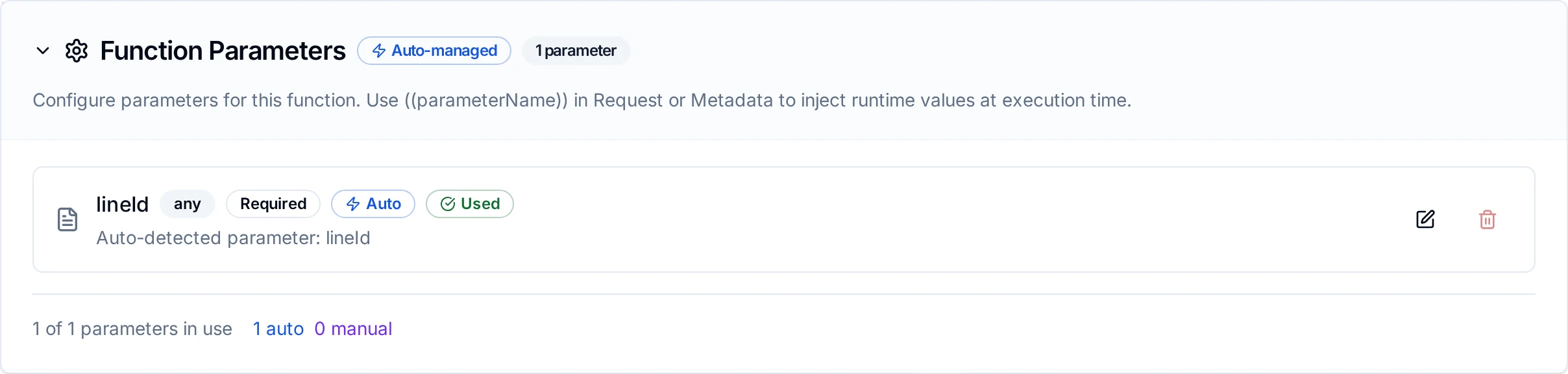
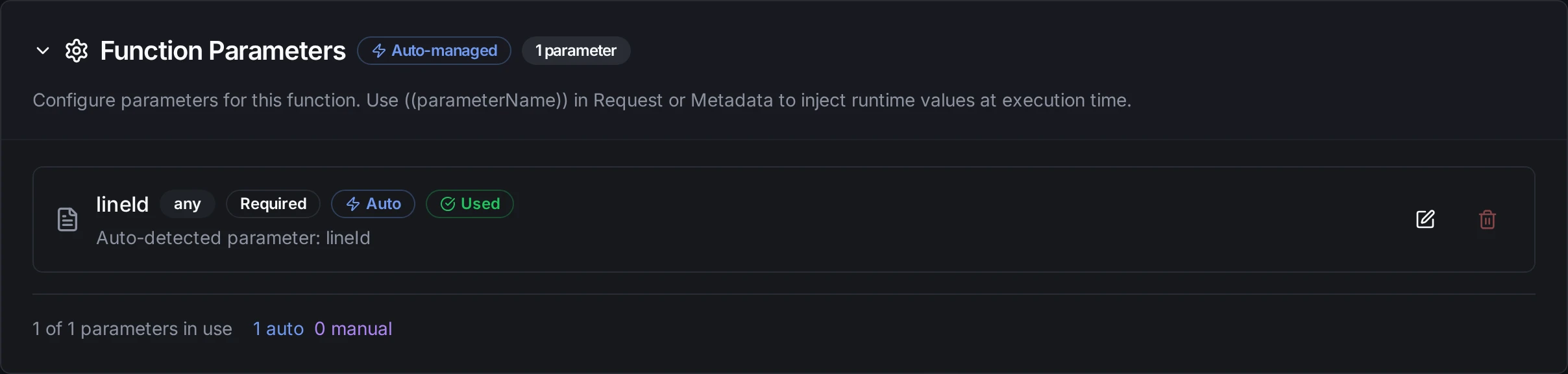
A Call Read Method function whose request carries the ((lineId)) parameter
Each function checks the call before anything is sent: the method must be in the contract, and a request field its message does not define is refused by name.
How JSON maps to a message
Requests and answers follow the standard Protobuf JSON mapping.
| In the contract | In JSON |
|---|---|
| A 64-bit integer | Text, such as "18250", because a JSON number loses precision above 253. A request may give text or a number |
| An enum | Its name, such as "RUNNING". A request may give the name or the number |
| A Timestamp, a Duration | RFC 3339 text; seconds text such as "3.5s" |
| Bytes | Base64 text |
| A field left at its default | Written out (0, "", false), so a pipeline sees the same keys on every message. An unset sub-message is null; an unset optional field is left out |
The four kinds of method
| Method kind | What the function does |
|---|---|
| One request, one answer | Sends the request and returns the answer in result.response |
| One request, a stream of answers | Collects the answers in result.responses until the server ends the stream or Max Responses is reached; result.complete says which |
| A stream of requests, one answer | Sends the list of messages on one call and returns the answer |
| A stream of requests and a stream of answers | Sends the list of messages and collects the answers, reading while it sends |
A conversation that stays open across several pipeline runs is not supported.
gRPC defines no idempotency key: a method called twice may act twice. The connector sends a write once. A write whose answer was lost (a timeout, a dropped connection) may already have run on the server: check the server before running it again. With store-and-forward on, a buffered write is sent when the link returns and carries the idempotency-key metadata entry, for a service that honours it.
Subscribe
| Field | Required | Description |
|---|---|---|
| Method | Yes | A server-streaming method, as package.Service/Method |
| Request | No | The one request message the stream is opened with, as JSON. Sent as written: it cannot hold ((parameters)) |
| Metadata | No | A JSON object of metadata sent when the stream is opened |
A Subscribe function is the source of the gRPC trigger. gRPC has no replay: messages the server sent while the connection was down are not delivered afterwards.
Pipeline Integration
Each call operation is its own node in the Pipeline Designer, under APIs: gRPC Call Read Method and gRPC Call Write Method. The gRPC nodes page lists what they return, and the gRPC trigger page what a stream message carries.
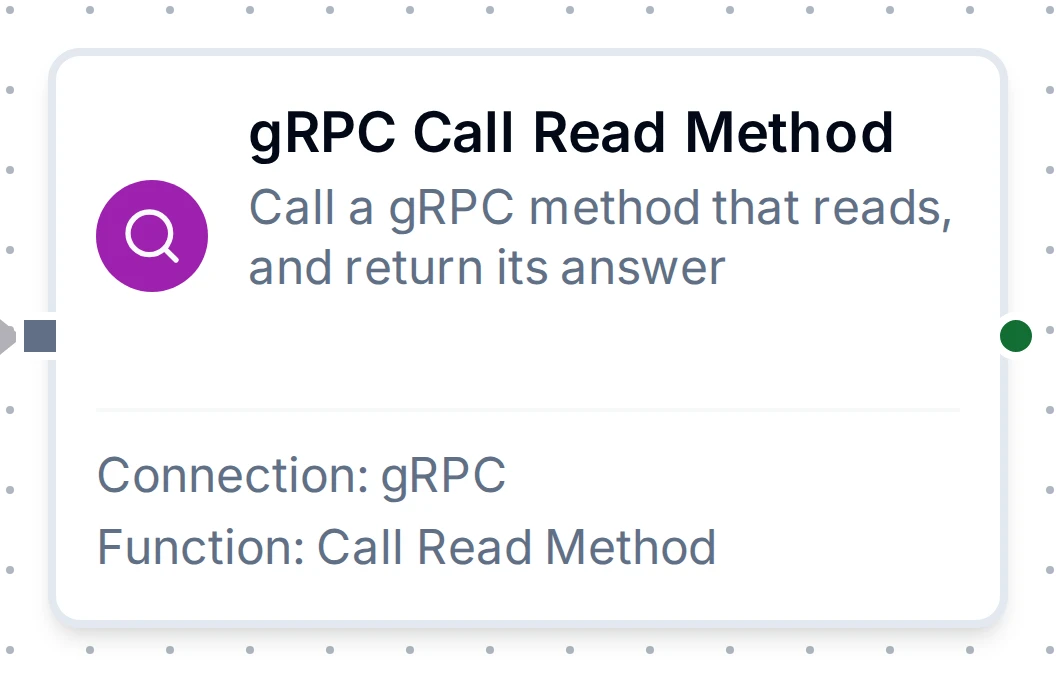
The gRPC Call Read Method node with its connection and function
Common Use Cases
Read a line's status from a service
gRPC Call Read Method with method plant.v1.LineService/GetLineStatus and request {"lineId": "((lineId))"}, then a condition on $node["Status"].result.response.state.
Report production when a batch ends
- A trigger fires when the batch counter resets.
- gRPC Call Write Method with the MES's report method and request
{"workOrderId": "((workOrderId))", "quantity": ((count))}.
Start a pipeline on every status change
A Subscribe function on plant.v1.LineService/WatchLine with request {"lineId": "L3"}, and a gRPC trigger on it.
Troubleshooting
| What you see | Cause and fix |
|---|---|
| "this server does not offer server reflection" | Reflection is switched off at the server. Set Contract Source to files and upload its .proto files, or to descriptor |
| "the server did not complete the HTTP/2 handshake" | Use TLS does not match the server, or the port is not a gRPC port |
| "the server answered HTTP 404, not gRPC" | A web server or a proxy answered on that address. Check the host and port |
| A certificate error at connect | The server's certificate is not signed by a CA MaestroHub trusts: add the CA certificate, or set Server Name when the certificate names another host |
UNAUTHENTICATED at connect | The server refuses the credentials |
| "method ... is not in this connection's contract" | The contract does not define the method. With reflection, the server is asked once more before this is said; with uploaded files, upload the current ones |
| "the request does not fit ...: unknown field" | The request names a field the message does not define. Compare it with the template the form fills in |
RESOURCE_EXHAUSTED on a large answer | A message is larger than Max Message Size. Raise it on the connection |
result.complete is false | Max Responses stopped the read. Raise it, or narrow the request |