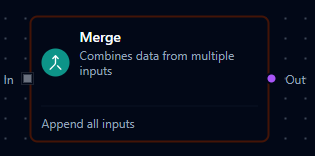
Merge node
Merge Node
Overview
The Merge Node consolidates payloads from two or more upstream branches into a single output. It always waits until every connected input delivers data, then merges the values according to the selected mode. Use it to fan-in parallel branches, stitch together batched results, or normalize multiple feeds for downstream processing.
Core Functionality
1. Wait-All Synchronization
- A single logical
inputport accepts multiple edges. - Execution is forced into
wait_all; the node fires only after every upstream branch completes. - Validation ensures at least two connections exist to prevent misconfigured merges.
2. Flexible Merge Modes
append(default) concatenates all incoming arrays or items in deterministic order (sources sorted alphabetically by node name).combinezips items positionally, producing composite objects; unmatched positions can be preserved or dropped.- Other modes remain reserved for future releases and are rejected during validation if selected.
3. Auto-Normalization
- Each inbound payload is coerced into an array before processing, regardless of original shape.
- Mixed primitives and objects are supported—scalars become single-element arrays.
- In
combinemode, fields are prefixed with the source identifier (such asinput_0_field) to avoid collisions.
4. Output Metadata
- The
mergedoutput includes metadata keys likemergeMode,inputCount,itemCount, andprocessed_by="merge"for observability. - Downstream nodes receive a single array representing the merged content.
5. Standard Settings
- Inherits core execution settings (
Retry on Fail,On Error) and documentation options. - Input settings are fixed (
syncMode = wait_all,waitTimeout = 30s) and not user-editable.
Configuration Reference
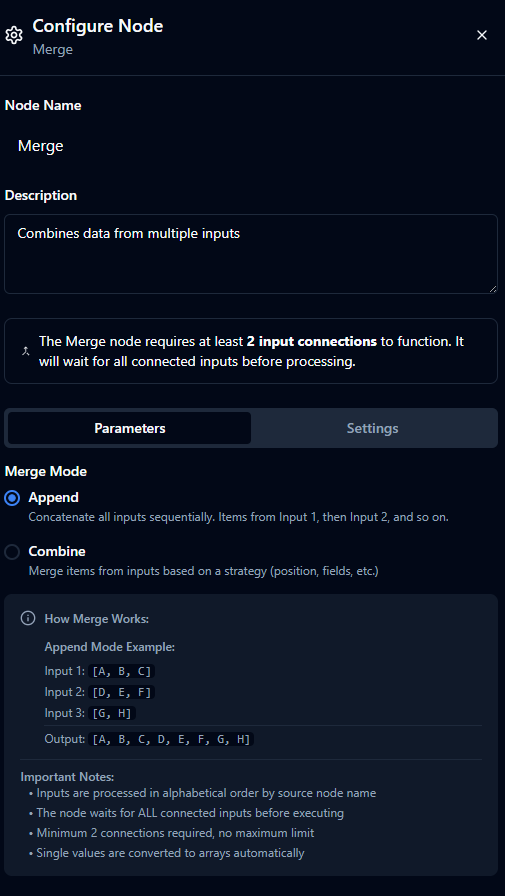
Parameters Configuration
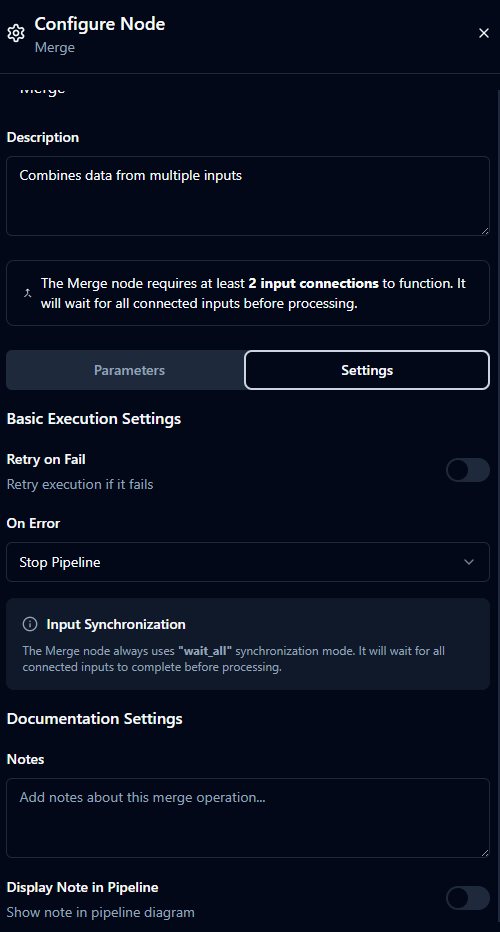
Settings Configuration
Parameters (Dynamic Data)
| Field | Type | Default | Description |
|---|---|---|---|
| Merge Mode | string | "append" | Merge strategy ("append" or "combine"). |
| Combine By | string | "position" | Used when Mode is "combine"; currently only "position" is supported. “By position” aligns elements that share the same index across every upstream list—first with first, second with second—and stitches each aligned set into a single record. |
| Keep Unmatched Items | boolean | true | When true, extra rows from longer inputs are kept and missing sources remain empty in the merged result. When false, any row missing data from one or more sources is discarded so only fully matched positions are emitted. |
Settings (Static Configuration)
| Field | Type | Default | Description |
|---|---|---|---|
| Retry on Fail | boolean | false | Retries merge execution when infrastructure errors occur. |
| On Error | string | "Stop Pipeline" | "Stop Pipeline" fails the run, "Continue Execution" emits an error packet, "Retry Node" repeats under retry rules. |
| Notes | string | "" | Describe the fan-in purpose and expected structure. |
| Display Note in Pipeline | boolean | false | Shows the note on the canvas for quick reference. |
Usage Examples
Example 1: Append Finished Goods
| Field | Value |
|---|---|
| Mode | Append |
| Notes | Combine pallets from parallel pack lines. |
Line A emits [{"palletId":"A-101"},{"palletId":"A-102"}] while Line B emits [{"palletId":"B-201"}]. The merge node delivers a single array with all pallets in alphabetical order by source, ready for warehouse dispatch.
Example 2: Combine Torque and Temperature Samples
| Field | Value |
|---|---|
| Mode | Combine |
| Combine By | By Position |
| Keep Unmatched Items | true |
| Notes | Zip torque and temperature readings for SPC. |
Torque stream → [{"torqueNm":32.4},{"torqueNm":31.8}]
Temperature stream → [{"tempC":145.2},{"tempC":146.1},{"tempC":144.7}]
Output:
- input_0_torqueNm: 32.4
  input_1_tempC: 145.2
- input_0_torqueNm: 31.8
  input_1_tempC: 146.1
- input_1_tempC: 144.7
Leaving Keep Unmatched Items at true preserves the final temperature sample even without a torque partner.
Example 3: Align Inspection Flags with Counts
| Field | Value |
|---|---|
| Mode | combine |
| Combine By | position |
| Keep Unmatched Items | false |
| On Error | Continue Execution |
Inspection node outputs [{"station":"Laser","flag":"OK"},{"station":"Vision","flag":"REVIEW"}]. A counter node provides [{"count":120},{"count":118}]. Combined results yield paired objects such as { input_0_station: "Laser", input_0_flag: "OK", input_1_count: 120 }. Because Keep Unmatched Items is false, any extra counts or flags are discarded to maintain alignment.